

Article-At-A-Glance
- Hermes Agent is an open-source AI agent built by Nous Research that remembers what it learns — creating reusable skills from completed tasks and building a persistent user model across sessions.
- Unlike every other agent framework, Hermes has a built-in learning loop baked into its architecture, not bolted on as an afterthought — meaning it compounds knowledge the more you use it.
- Hermes ships with 47 built-in tools, MCP server integration, voice mode, and a pluggable memory backend — making it one of the most complete open-source agent frameworks available today.
- The comparison between Hermes and OpenClaw reveals something unexpected — running both together may produce better outcomes than picking one.
Hermes Agent Remembers What Other AI Agents Forget
Every AI agent you’ve used before this one has the same quiet flaw: when the session ends, everything it learned disappears.
That’s not a minor inconvenience — it’s a structural ceiling on what AI agents can actually do for developers. Each task starts from the same baseline. Each workflow gets rebuilt from scratch. Every preference you’ve demonstrated, every pattern the agent observed, every shortcut it discovered — gone. The agent doesn’t grow. It just executes, resets, and waits for the next instruction. For teams running repetitive workflows or complex multi-step pipelines, this stateless design quietly kills productivity at scale.
Why Stateless Agents Hold Developers Back
The standard agent loop looks like this: receive task → plan → execute → return result. It’s clean, predictable, and completely amnesiac. Most frameworks are optimized around that loop because it’s easier to build, easier to test, and easier to scale horizontally. What it isn’t is capable of improvement. A stateless agent running your CI/CD diagnostics on day 90 is identical to the one running it on day one. It has learned nothing. You’ve gained nothing from repeated use beyond whatever you manually documented yourself.
How Hermes Breaks the Reset-Every-Session Pattern
Hermes Agent adds a critical layer that fires after execution completes. Instead of closing the loop and waiting for the next task, it evaluates what just happened, extracts reusable patterns from successful completions, and stores them as skills. It also builds a persistent model of the user — tracking preferences, decision history, and task patterns that carry forward into every future session. The result is an agent that gets measurably better the more you use it, not one that stays frozen at its initial capability ceiling.
This isn’t a memory feature in the way most people think about AI memory — it’s an architectural commitment. The self-improvement loop isn’t a plugin or an optional module. It is the reason Hermes exists as a separate project at all.
What Hermes Agent Actually Is
Hermes Agent is an open-source autonomous AI agent framework built by Nous Research. It is designed from the ground up to learn over time, accumulate reusable skills, and model the individual user across sessions — producing an agent that compounds its own capabilities through use rather than requiring manual configuration updates every time your workflow evolves.
Built by Nous Research on the Hermes-3 Model Family
Nous Research built the Hermes-3 model family specifically to support this kind of persistent, learning-oriented agent behavior. Hermes-3 isn’t a generic base model adaptation — it was trained with the explicit goal of supporting agents that improve through experience. That training foundation is what makes the skills system and user modeling work at the level they do, rather than producing shallow memory that degrades or hallucinates over time.
The project launched as an open-source autonomous agent, and the community response was immediate. Developers recognized quickly that this wasn’t another wrapper around a foundation model with a memory plugin attached — it was a fundamentally different approach to what an agent framework should do.
Trained on Llama 3.1 With the Atropos RL Stack
Hermes-3 was trained on Llama 3.1 using Nous Research’s Atropos reinforcement learning stack. The Atropos RL stack is what enables the fine-tuning and self-improvement mechanisms that make Hermes distinct from frameworks built on standard supervised fine-tuning alone. Reinforcement learning at the training level produces a model that is structurally prepared to evaluate its own outputs and improve from feedback — which is exactly what the learning loop requires.
Open-Source, Terminal-Based, and Free to Run When Idle
Hermes runs in terminal and costs nothing when idle — a significant practical advantage for teams managing infrastructure budgets. Being open-source means you own the deployment, the data, and the memory backend. Nothing is locked to a proprietary cloud. For developers who’ve grown uncomfortable with how much usage data commercial agent platforms accumulate, that control is a meaningful differentiator.
The Learning Loop: How Hermes Gets Smarter Over Time
The learning loop is the architecture that separates Hermes from every other open-source agent framework currently available. Understanding it precisely matters if you’re evaluating whether Hermes fits your stack. For a comparison of enterprise AI solutions, including OpenAI and Anthropic, you can explore more details.
Execute, Evaluate, Extract, Refine, Retrieve
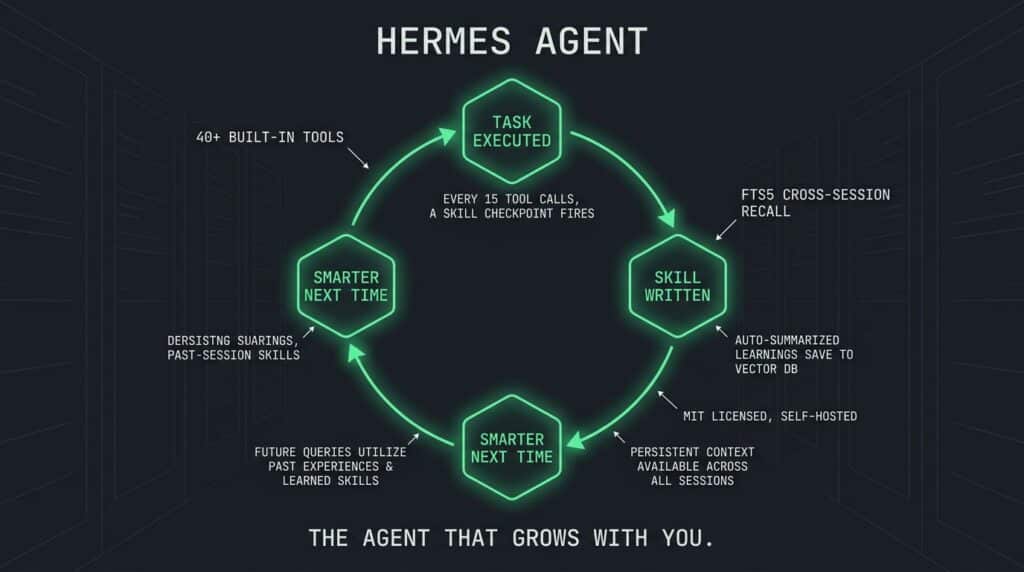
The Hermes learning loop operates in five stages that run sequentially after every task completion. First, the agent executes the task using available tools and its current skill library. Then it evaluates what happened — did it succeed, where did it struggle, what pattern produced the best result? Next it extracts reusable components from that evaluation and encodes them as skills. Over subsequent runs, those skills get refined based on new outcomes. Finally, on future tasks, the agent retrieves the most relevant skills automatically before planning begins.
- Execute: Task runs using current tools and stored skills
- Evaluate: Agent assesses outcome quality and identifies friction points
- Extract: Reusable patterns are pulled from successful completions and encoded
- Refine: Stored skills are updated based on new execution results
- Retrieve: Relevant skills are automatically loaded before future task planning begins
This isn’t a summarization of chat history. It is a structured, compounding knowledge system that produces a fundamentally different kind of agent over time, similar to the advancements seen in Meta’s Muse Spark AI model.
How the Skills System Saves and Reuses Workflows
Every workflow Hermes completes successfully becomes a candidate for skill creation. The skills system saves these as discrete, reusable procedures stored in the Skills Hub. When a similar task arrives in a future session, Hermes pulls the relevant skill before it begins planning — meaning it doesn’t rediscover the optimal approach from scratch each time. It builds on what already worked. For developers running repetitive pipelines, this compounds into serious time savings across weeks and months of use. For a broader understanding of how AI tools like Hermes are transforming business automation, you might consider reading this comparison of Microsoft Copilot and ChatGPT.
Critically, skills aren’t static snapshots. Hermes can create, update, and delete its own procedures as it learns better approaches. The agent isn’t locked into its first successful strategy — it keeps improving the skill as it accumulates more execution data. For a deeper understanding of how AI agents like Hermes are evolving, you might explore the Gemma 4 open models release by Google.
How User Modeling Builds Persistent Preferences Across Sessions
Parallel to the skills system, Hermes builds a persistent model of the individual user. It tracks preferences, decision history, communication style, and task patterns — and that model grows across every session. A developer who consistently prefers concise output over detailed explanations, or who always routes certain task types through a specific tool chain, will find that Hermes learns those patterns and applies them automatically. This is what makes long-term use feel qualitatively different from day-one use — the agent starts to anticipate rather than just respond.
47 Built-In Tools and What They Cover
Hermes ships with 47 built-in tools out of the box — and the breadth of that toolset is what makes it immediately useful without requiring extensive custom integration work. The tools span file system operations, web browsing, code execution, data processing, API interaction, and more. Most agent frameworks give you a handful of core tools and expect you to build the rest. Hermes gives you a working toolkit that covers the majority of real developer workflows before you write a single line of custom integration code.
MCP Server Integration, Voice Mode, and Pluggable Memory Backends
Beyond the built-in tools, Hermes supports Model Context Protocol (MCP) server integration — which dramatically expands what the agent can connect to and act on across your existing infrastructure. MCP has become a key standard for giving AI agents structured access to external systems, and Hermes treats it as a first-class feature rather than an afterthought.
Voice mode support is available across all platforms, which makes Hermes viable in hands-free developer workflows — something few open-source agent frameworks have bothered to build properly. It’s not a novelty implementation. Voice mode in Hermes is designed to work with the same skill system and memory architecture that powers text-based interactions, so the agent’s learned behaviors carry across input modalities.
The pluggable memory backend architecture is one of the more technically significant design decisions in the project. Rather than locking you into a single memory storage solution, Hermes lets you swap in the backend that fits your infrastructure — whether that’s a local vector store, a managed database, or a custom implementation. For those interested in enterprise-level AI solutions, you might consider exploring the comparison of OpenAI and Anthropic Claude to understand how these platforms handle similar challenges.
Together, these three capabilities — MCP integration, voice mode, and pluggable memory — make Hermes a genuinely production-ready framework rather than a research demo that needs months of hardening before it touches real workloads. Here’s what each layer brings to a production deployment:
- MCP Server Integration: Connects Hermes to external tools, APIs, and data sources using a standardized protocol — no custom connector code required for supported systems
- Voice Mode: Full voice interaction across all platforms, with skill and memory systems intact across modalities
- Pluggable Memory Backends: Swap storage layers without touching agent logic — local vector stores, managed databases, or custom backends all supported
- Skills Hub: Centralized storage and retrieval for all learned procedures, accessible across sessions and deployable across agent instances
- Persistent User Profiles: Cross-session user modeling stored in the memory backend of your choice
What MCP Integration Enables for Developers
MCP integration means Hermes can reach into your existing tooling ecosystem without requiring you to rebuild connection logic from scratch. If your infrastructure already exposes MCP-compatible endpoints — and increasingly it does, as the standard gains adoption across developer tooling — Hermes can interact with those systems immediately. That’s a significant reduction in the integration overhead that typically delays agent deployments by weeks. For a deeper understanding of business process management and its impact on integration, you can explore further resources.
For teams running complex internal tooling stacks, this is the feature that moves Hermes from “interesting experiment” to “viable production agent.” The agent can query internal knowledge bases, trigger build pipelines, interact with monitoring systems, and pull context from project management tools — all through the same MCP layer, without fragile custom integrations breaking every time an upstream API changes.
Pluggable Memory Backend Architecture Explained
The pluggable backend design means the memory layer is decoupled from the agent logic entirely. Hermes stores skills, user profiles, and session data through an abstraction layer that can point to different storage implementations depending on your deployment requirements. A solo developer running Hermes locally might use a lightweight local vector store. An enterprise team might route memory storage through a managed database with access controls and audit logging.
This matters beyond just technical flexibility. It means your agent’s accumulated knowledge — the skills it has built, the user preferences it has modeled, the workflows it has optimized — is portable. You’re not locked into a proprietary memory format that only works within one platform. The data lives where you put it, in the format you control.
It also means teams can design memory retention policies that match their compliance requirements. If certain data cannot persist beyond a session boundary for regulatory reasons, the backend architecture supports that constraint without requiring you to modify the agent itself.
Hermes vs. OpenClaw: Different Tools, Not Direct Rivals
Framing Hermes and OpenClaw as direct competitors misses what makes each one valuable. They were built with different core philosophies, and understanding where each one excels makes the choice — or the combination — much clearer.
Where OpenClaw Has the Edge
OpenClaw has lower setup complexity. For teams that need broad, one-off task coverage with minimal configuration overhead, OpenClaw gets you there faster. It’s the better choice when you need an agent operational immediately and the use case doesn’t involve repeated workflows where compounding memory would pay off.
Cross-session user modeling in OpenClaw is more limited compared to Hermes, but for many single-session task types, that limitation simply doesn’t matter. If you’re running one-shot research tasks, content generation jobs, or exploratory queries that don’t repeat, OpenClaw’s simpler architecture is an asset rather than a constraint.
Where Hermes Outperforms
Hermes is the clear choice the moment repeated workflows enter the picture. Any task your team runs more than a few times per week is a candidate for skill creation — and every skill Hermes creates reduces the execution overhead on subsequent runs. The more repetitive your workload, the faster the compounding effect becomes visible. Hermes also wins decisively on user modeling depth, with persistent cross-session profiles that OpenClaw’s architecture simply wasn’t built to match.
Why Running Both Produces Better Results Than Choosing One
The most sophisticated teams evaluating these frameworks aren’t choosing between them — they’re routing tasks based on fit. OpenClaw handles the broad, unpredictable, one-off queries. Hermes handles the repeated, high-value workflows where skill accumulation produces measurable efficiency gains over time.
This split-routing approach plays to the architectural strengths of both frameworks without asking either one to operate outside its design intent. OpenClaw doesn’t need to be retrofitted with a memory system it wasn’t built for. Hermes doesn’t need to be simplified to handle one-shot queries it’s architecturally over-engineered for.
The comparison table below captures the key differences at a glance:
|
Feature |
Hermes Agent |
OpenClaw |
|---|---|---|
|
Skill creation from experience |
✓ |
✗ |
|
Skill refinement over time |
✓ |
✗ |
|
Cross-session user modeling |
✓ |
Limited |
|
Reactive tool use |
✓ |
✓ |
|
Multi-agent support |
✓ |
✓ |
|
Open source |
✓ |
✓ |
|
Setup complexity |
Moderate |
Low |
Who Gets the Most Value From Hermes Agent
Hermes isn’t the right tool for every use case — but for the use cases it fits, the compounding advantage it produces over time is difficult to replicate with any other open-source framework currently available.
Developers Splitting Workloads Across Models
Developers who run multiple models in parallel — routing tasks based on cost, latency, or capability — get immediate value from Hermes’s skill portability. Skills built during runs on one model can inform agent behavior across the entire deployment, meaning the knowledge compounds across your model fleet rather than siloing within a single model’s context window.
For developers managing hybrid local/cloud deployments, Hermes’s architecture supports running on budget hardware through LMStudio compatibility. The agent’s capability doesn’t degrade proportionally to the hardware tier the way monolithic cloud-dependent frameworks do, because the skill library handles much of what would otherwise require expensive model calls.
The workload-splitting use case also benefits from Hermes’s user modeling. When different models handle different task types but serve the same developer, a shared persistent user profile means each model instance starts with context rather than from zero — reducing the re-explanation overhead that plagues multi-model workflows.
- Skill portability across model instances reduces redundant learning cycles
- LMStudio compatibility enables full capability on budget local hardware
- Shared persistent user profiles eliminate re-explanation overhead across model switches
- Pluggable memory backends support unified knowledge storage across heterogeneous deployments
- The learning loop compounds value across the entire model fleet, not just individual runs
Data Scientists Using Built-In Fine-Tuning and RL Tools
Data scientists get a distinct advantage from the Atropos RL stack that underpins Hermes-3. The same reinforcement learning infrastructure used to train the base model is accessible for fine-tuning workflows — meaning data scientists can use Hermes not just as an execution agent but as a platform for iterative model improvement aligned with their specific domain data and task requirements.
For teams running experimental pipelines where the agent needs to adapt to shifting data distributions or evolving task definitions, the built-in RL tooling removes the need to bolt a separate fine-tuning infrastructure onto an agent framework that wasn’t designed to support it. That consolidation meaningfully reduces the infrastructure surface area you need to maintain. For instance, Google’s Gemma 4 release highlights advancements in model adaptability and infrastructure efficiency.
Teams Running on Budget Hardware With LMStudio
Teams constrained by infrastructure budgets don’t have to sacrifice agent capability to stay within cost limits. Hermes runs on local hardware through LMStudio compatibility, meaning the full learning loop — skill creation, user modeling, persistent memory — operates on commodity hardware without cloud inference costs. The skill library effectively acts as a cost-reduction mechanism: the more skills Hermes accumulates, the fewer expensive model calls it needs to make to handle familiar task types. Learn more about how Meta Muse’s AI model enhances capabilities while managing costs effectively.
How to Integrate Hermes Into Existing Workflows
Getting Hermes into a production workflow has two distinct paths depending on your team’s technical capacity and appetite for infrastructure ownership. The first is a direct self-hosted deployment where you manage the agent, the memory backend, and the integration layer yourself. The second routes through MindStudio, which handles the infrastructure complexity so your team can focus on building with the agent rather than maintaining it.
The self-hosted path gives you maximum control — over data residency, memory backend selection, model versioning, and deployment architecture. It requires moderate technical expertise to configure correctly, but Hermes’s documentation covers the setup process in enough detail that experienced developers can move from installation to first skill creation within a single working session. The terminal-based interface keeps the operational surface area manageable once the initial configuration is complete.
MindStudio Agent Skills Plugin for Infrastructure Integration
For developers building on Hermes directly, the MindStudio Agent Skills Plugin solves the integration infrastructure layer — which is consistently the most time-consuming part of any agent deployment that isn’t a standalone prototype. The plugin handles the connective tissue between Hermes’s skill system and your existing tooling, reducing the custom integration code required to route skills, memory updates, and task outputs through your workflow infrastructure.
The practical effect is that your team spends engineering time on the agent behaviors that matter to your product, not on rebuilding integration plumbing that the plugin already handles. For teams where backend engineering capacity is limited, that reallocation of effort is immediately felt in delivery velocity.
The plugin also means that as MindStudio expands its integration surface — adding new connectors, updating MCP support, extending memory backend compatibility — those improvements flow through to your Hermes deployment without requiring you to rearchitect the integration layer each time. You get the compounding benefit of both Hermes’s learning loop and MindStudio’s ongoing infrastructure development.
No-Code Path via MindStudio for Teams Skipping Self-Hosting
Teams that want Hermes-level capability without the operational overhead of self-hosting have a direct path through MindStudio’s platform. MindStudio offers a no-code environment that gives you access to capable, multi-agent AI workflows — including the skill accumulation and persistent memory behaviors that define Hermes — without requiring you to manage servers, configure memory backends, or maintain model infrastructure. You can start free at mindstudio.ai and have a working agent workflow running faster than any self-hosted deployment allows.
This path is particularly valuable for product teams that need AI agent capabilities embedded in their workflows but don’t have dedicated ML infrastructure engineers available to manage a self-hosted deployment. The no-code interface doesn’t sacrifice depth — it abstracts the infrastructure while preserving access to the underlying capability that makes Hermes worth deploying in the first place.
Hermes Agent Is the First Framework Built to Compound Developer Knowledge
Every other open-source agent framework treats each session as self-contained. That design decision has consequences that accumulate quietly over months of use — your team keeps re-solving the same problems, re-explaining the same preferences, re-configuring the same workflows. The overhead feels small per session, but across a team running agent workflows daily, it adds up to a significant and entirely avoidable productivity drain.
Hermes eliminates that drain by design. The skills system means solved problems stay solved. User modeling means stated preferences don’t need to be restated. The learning loop means every task your team runs makes the agent incrementally more capable on the next one. No other open-source framework has built this compounding mechanism at the architectural level — it’s the single most important differentiator in the current agent landscape.
For development teams evaluating where to invest their agent infrastructure effort, that compounding dynamic changes the calculus entirely. A framework that improves through use isn’t just a better tool today — it becomes a more valuable tool every week you continue using it. That trajectory is what separates Hermes from frameworks that plateau at their initial capability ceiling and stay there.
Frequently Asked Questions
Quick Reference: Hermes Agent Core Facts
• Built by: Nous Research
• Base model: Hermes-3, trained on Llama 3.1
• Training stack: Atropos RL
• Built-in tools: 47
• Memory type: Persistent, cross-session, pluggable backend
• Setup complexity: Moderate (self-hosted) / Low (via MindStudio)
• Cost when idle: Free
• Interface: Terminal-based
• Key differentiator: Skills system with self-improvement loop
Is Hermes Agent completely free to use?
Hermes Agent is open-source and free to run, with no cost when the agent is idle. Running it on your own infrastructure means your primary costs are compute — which scales with usage rather than being a flat subscription fee. For teams running Hermes on local hardware through LMStudio, the infrastructure cost can be effectively zero beyond the initial hardware investment.
The MindStudio path offers a free starting point as well, with the option to scale as your usage grows. Neither path requires upfront licensing fees or proprietary model access costs, which makes Hermes one of the most cost-accessible production-grade agent frameworks currently available.
Can Hermes Agent run on local hardware without cloud infrastructure?
Yes — Hermes is fully compatible with local deployment through LMStudio, which means the complete agent stack including the learning loop, skill system, and persistent memory can operate entirely on local hardware without any cloud dependency. This makes Hermes viable for teams with data residency requirements, air-gapped environments, or strict controls on what data leaves the local network.
Local deployment also means the agent’s accumulated knowledge — its skills library, user profiles, and session memory — never transits a network boundary you don’t control. For security-conscious development teams, that data ownership is a significant practical advantage over cloud-dependent agent frameworks where memory storage is managed by the platform provider.
How does Hermes Agent’s skills system differ from standard AI memory features?
Standard AI memory features typically store and retrieve conversation history or summarized context — they give the model access to what was said before, but they don’t extract reusable procedural knowledge from successful task completions. Hermes’s skills system operates at a fundamentally different level: it identifies the patterns that produced successful outcomes, encodes them as discrete reusable procedures, and stores them in a way that improves future task planning rather than just providing historical context.
The practical difference is significant. A conversation history tells the agent what happened. A skill tells the agent what works — and gives it a starting point for the next similar task that’s already optimized rather than generic. Skills also get refined over time as Hermes accumulates more execution data, which means the knowledge in the skills library improves with use rather than becoming stale or irrelevant as workflows evolve.
Does Hermes Agent work with models other than Llama 3.1?
Hermes-3 was trained on Llama 3.1 using the Atropos RL stack, and that’s the primary model family the framework is designed around. The Hermes-3 model family is specifically optimized for the kind of learning-loop behavior and skill extraction that defines the framework’s core functionality — using a different base model would require verifying compatibility with those architectural requirements before relying on the learning and memory features in production. For instance, exploring the capabilities of Meta’s Muse Spark AI model could offer insights into potential alternatives.
What is the MindStudio Agent Skills Plugin and do I need it to use Hermes?
The MindStudio Agent Skills Plugin is an integration infrastructure layer built specifically for developers deploying Hermes in existing workflow environments. It handles the connective tissue between Hermes’s skill system, memory backend, and your external tooling — reducing the amount of custom integration code your team needs to write and maintain to get Hermes operating as part of a larger system rather than as a standalone agent.
You do not need the plugin to use Hermes. If you’re running a self-contained Hermes deployment with no external system integrations, the plugin adds nothing you require. Where it becomes valuable is in production environments where Hermes needs to interact with other tools, APIs, databases, or workflow systems — which describes most real developer deployments beyond initial experimentation.
For teams using MindStudio’s platform directly rather than self-hosting Hermes, the plugin’s functionality is effectively built into the platform — you get the integration infrastructure benefits without managing the plugin as a separate component. That’s one of the practical reasons teams evaluating Hermes for production use often end up starting their evaluation through MindStudio’s free tier before committing to a self-hosted architecture.