

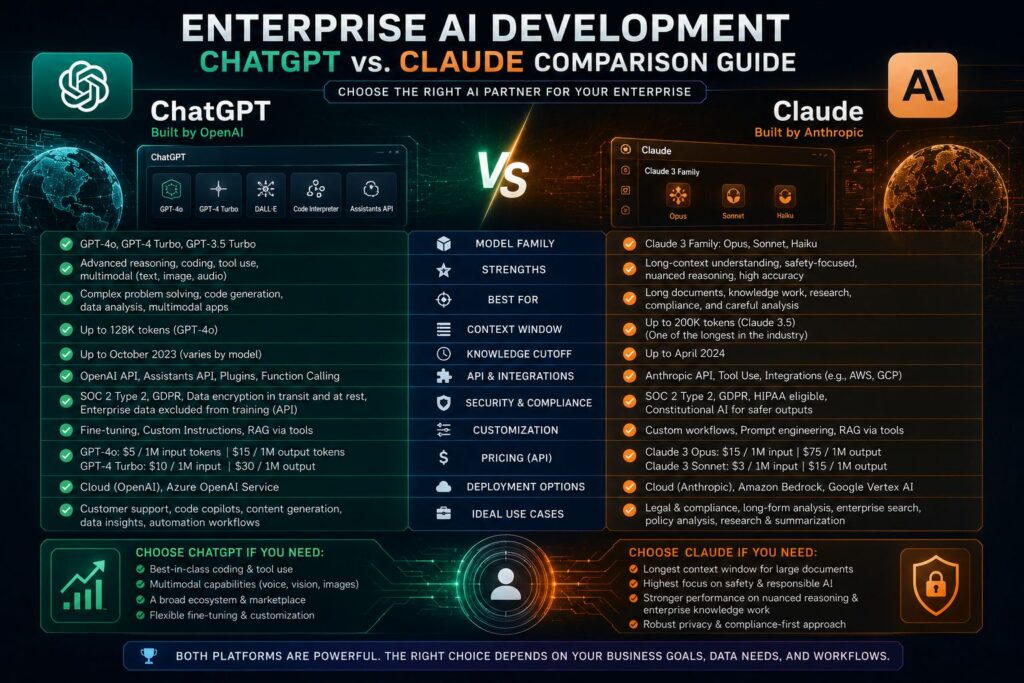
- ChatGPT Enterprise runs on the GPT-5 series and excels at broad, multi-modal tasks — text, voice, vision, and code — with one of the richest plugin and integration ecosystems available.
- Claude Enterprise leads in long-context document analysis (up to 500K tokens), precise instruction-following, and safety-first design, making it the stronger choice for knowledge-intensive workflows.
- The right platform isn’t about which AI is “smarter” — it’s about which one fits your specific enterprise workflow, compliance requirements, and team structure.
- Pricing, context window size, and multi-modal capability gaps between the two platforms are closing fast, but key strategic differences remain that could define your AI roadmap.
- Many enterprise teams are now running both platforms simultaneously for different departments — a trend worth understanding before you commit to a single vendor.
Choosing between ChatGPT Enterprise and Claude Enterprise isn’t just a software decision — it’s a strategic call that shapes how your entire organization thinks, works, and competes.
As we approach 2026, both platforms have developed significantly, and the once wide gap that made this decision easy has considerably reduced. Both OpenAI and Anthropic have focused on enterprise features, security controls, and model performance. Now, the difference between them is their philosophy, architecture, and fit, not just raw capability. Intuition Labs, which closely monitors enterprise AI adoption, states that the most common error organizations make is assessing these platforms based on benchmarks rather than how they align with actual workflows.
Quick Overview: Comparing ChatGPT and Claude Enterprise
- ChatGPT Enterprise is designed for a wide range of applications, seamless integrations, and multi-modal adaptability
- Claude Enterprise is designed for deep understanding, accurate instruction execution, and document-intensive workflows
- Context windows have expanded to 500K tokens for Claude, compared to the large but currently smaller windows of GPT-5
- Both systems provide enterprise-level security, but their compliance architectures are distinct in significant ways
- The decision-making framework is more important than benchmark scores
Two Contrasting AI Approaches, One Crucial Business Choice
OpenAI created ChatGPT as an AI multi-tool — capable of performing nearly any task reasonably well, integrating with tools your team is already familiar with, and usable by non-technical users from the start. Anthropic, on the other hand, designed Claude from scratch using Constitutional AI principles, prioritizing safety, accuracy, and dependability over a wide range of features.
The philosophical difference between ChatGPT Enterprise and Claude is evident in their practical applications, which are important to enterprise teams. ChatGPT Enterprise usually provides more comprehensive responses that cover a wide range of perspectives. On the other hand, Claude tends to provide more succinct and direct responses that adhere more accurately to complex instructions. Neither method is inherently better than the other; they simply reflect different beliefs about what enterprise users truly require.
The actual point of decision isn’t about which model gets the highest score on a leaderboard. Instead, it’s about which model’s strengths match the most crucial workflows of your business. A legal team that processes contracts that are a thousand pages long has different needs than a marketing team that generates campaign copy on a large scale. Understanding this difference is the first step in any serious evaluation of enterprise AI.
ChatGPT Enterprise: What It Brings to the Table in 2026
ChatGPT Enterprise is a subscription-based platform that utilizes the power of OpenAI’s GPT-5 series. It provides unlimited high-speed access, advanced admin controls, and a wide range of enterprise tools. It is tailored to meet the diverse AI needs of large organizations across various departments, including automating customer support, improving developer productivity, and enhancing executive research workflows.
ChatGPT Enterprise Core Specs (2026): Powered by GPT-5 series models including GPT-5.1 and GPT-5.4. Offers three operational modes: Instant (speed-optimized), Thinking (reasoning-optimized), and Pro (research-grade depth). Supports text, code, vision, voice, and file analysis. Custom GPTs available for department-specific deployment. Enterprise admin console with usage analytics, SSO, and domain verification included.
The wide-ranging capabilities of ChatGPT Enterprise make it an attractive option for large organizations. Instead of using different tools for writing, coding assistance, data analysis, and customer interaction, enterprise teams can bring a lot of workflow automation under one roof. However, this breadth sometimes means sacrificing the precision and instruction-adherence that more specialized tasks require.
How GPT-5 Series Models Can Benefit Your Team
The GPT-5 series is a significant improvement over GPT-4, especially in terms of reasoning depth, following instructions, and completing multi-step tasks. The Thinking mode is particularly useful for enterprise applications such as financial modeling, legal analysis, and strategic planning – tasks that require the model to solve a problem instead of quickly finding an answer based on a pattern.
Enterprise subscribers have uncapped access to all model variants, which is a significant advantage. In reality, teams that exceed the token limits on consumer tiers often have to resort to using less powerful fallback models in the middle of a task. However, with the enterprise tier, your team will always operate on the full-power GPT-5, regardless of any sudden increases in demand.
Multiple Modes: Written, Coded, Visual, and Auditory
ChatGPT Enterprise is capable of handling multiple modes of input and output, including written text, code, images, voice, and documents. This makes it a valuable tool for roles that deal with multiple formats, such as a product manager who needs to upload wireframes for feedback, a financial analyst who needs to input scanned reports, or a sales team that uses voice-to-task workflows on mobile.
The voice mode has evolved remarkably in the business setting, allowing real-time spoken communication with the model that feels less like dictation and more like a productive conversation. This changes how AI is utilized daily, especially for field teams or executives who prefer not to type.
Customizing GPTs, Plugins, and the Extensive Ecosystem
ChatGPT Enterprise’s ecosystem is one of its most underappreciated benefits. It allows you to create and launch Custom GPTs, which are versions of the model specifically designed to be trained on your internal documentation, tone guidelines, and workflows. This provides enterprise teams with a level of customization that is difficult to match elsewhere.
Plugins and integrations can be used to connect ChatGPT to the tools that your teams are already using:
- Microsoft 365 and Teams integration for in-app AI assistance
- Salesforce and CRM connectors for sales workflow automation
- Slack integration for async AI collaboration
- API access for custom enterprise application development
- Data analysis plugins that connect directly to enterprise databases
- Code interpreter for live data manipulation and visualization
This depth of integration is where ChatGPT Enterprise earns its position for organizations that need AI embedded across the tech stack rather than operating as a standalone tool. The Custom GPT framework, in particular, allows non-technical department heads to deploy specialized AI assistants without requiring engineering resources for every build.
Claude Enterprise in 2026: What Does It Bring to the Table?
Anthropic’s Claude Enterprise is the embodiment of an AI assistant that prioritizes safety, precision, and deep-context reasoning over the number of features. This focus results in a platform that regularly surpasses ChatGPT in high-value enterprise situations, especially those that require the processing of large amounts of intricate text with a high degree of accuracy.
Designed for businesses where the price of an AI mistake is steep — such as law, finance, healthcare, industries with heavy compliance, and large-scale knowledge management — the platform is based on Claude’s newest Sonnet-series models. Anthropic’s Constitutional AI system incorporates safety considerations right into the model’s decision-making process, rather than adding them as afterthoughts.
Claude Sonnet Models and Their Main Design Objective
The Sonnet-series models from Claude are designed for what Anthropic describes as “careful reasoning” — generating outputs that are accurate, well-organized, and strictly adhere to the specific instructions provided. In enterprise testing environments, Claude regularly surpasses GPT-5 in tasks that necessitate adherence to complicated, multi-part instructions without deviation or creativity.
In regulated industries, this is extremely important. When a compliance team instructs an AI to review a contract based on a specific set of criteria and only highlight deviations – not propose enhancements, not rewrite sections, just highlight deviations – Claude’s ability to follow instructions exactly makes it significantly more dependable for that task than a model that naturally adds value through elaboration.
Why a Context Window of Up to 500K Tokens Is Important
One of the most unique features of Claude Enterprise is its context window, which currently supports up to 500K tokens. In layman’s terms, this means that the model can process a document of about 1,500 pages in one go without losing its coherence or “forgetting” the content of the first section when it gets to the last.
When it comes to enterprise applications such as due diligence reviews, synthesizing large-scale research, analyzing regulatory filings, or processing whole codebases, this is not a luxury, but a capability that defines the workflow. ChatGPT Enterprise has significantly increased its context windows, but Claude’s maximum is still larger. More importantly, Claude’s performance within large context windows tends to stay more consistent and accurate throughout the entire document.
Safety Architecture and Compliance Controls
Claude has a more in-depth safety architecture than the majority of enterprise AI platforms. Anthropic’s Constitutional AI method trains the model to compare its own outputs to a set of established principles before responding, rather than simply filtering afterwards. This design decision significantly reduces the risk exposure for businesses in sectors like healthcare, financial services, and law, where a compliance error or a hallucinated fact can have serious repercussions.
Claude Enterprise is fully equipped with SOC 2 Type II certification, configurations eligible for HIPAA, and strong data residency controls when it comes to compliance. Importantly, Anthropic’s enterprise agreement clearly states that customer data will never be used to train future models. This is a contractual guarantee that is of great importance to legal and procurement teams when assessing vendor risk.
Direct Comparison: Key Feature Showdown
Once you cut through the advertising jargon and focus on how these platforms truly operate on actual business tasks, you’ll see certain trends. Neither model reigns supreme in all areas — but each has specific strengths where it regularly excels, which should guide your implementation choices.
The comparison guide below will discuss the five most critical areas for enterprise teams when deciding on an AI platform: coding, document analysis, content creation, research, and instruction-following. Knowing which platform excels in each area and by what margin is the difference between a strategic AI deployment and a costly experiment.
Here’s a quick comparison of the two:
- Writing code: Claude is better at creating accurate, instruction-specific code. ChatGPT is better at a wider range of tasks and has better integrated developer tools.
- Analyzing documents: Claude’s 500K token context window gives it an advantage for workflows that involve large documents.
- Creating content: ChatGPT can create more content faster. Claude is better at creating longer, more nuanced pieces of writing.
- Researching and searching the web: ChatGPT’s integration with live web search gives it a clear advantage for retrieving real-time information.
- Following instructions: Claude is consistently better at complex, multi-part instructions with strict output requirements.
- Multi-modal tasks: ChatGPT Enterprise is better at tasks that involve voice, vision, and multiple formats.
These aren’t just small differences. In tests in enterprise environments, the differences in certain categories — particularly analyzing documents and following instructions — are big enough to have a significant impact on workflow outcomes, not just benchmark scores.
Programming: The Strengths of Each Model and the Reasons
Unobtrusively, Claude has become the favorite programming assistant for engineering teams who handle intricate, extensive codebases. Its capability to retain an entire codebase in context, courtesy of the enlarged context window, allows it to rationalize how a modification in one module impacts behavior in a module three files away. This type of systems-level reasoning makes it genuinely helpful for senior engineers, not just as an autocomplete tool, but also as a thinking companion during architecture evaluations and debugging sessions. For more insights, explore how Claude’s AI training enhances effectiveness.
When it comes to the breadth of the developer ecosystem, ChatGPT Enterprise comes out on top. It’s integrated with GitHub Copilot workflows, VS Code extensions, and the wider OpenAI API infrastructure. This makes it a more practical choice for teams who want AI directly embedded into their current development pipeline, rather than operating as a separate consultation tool. For teams who are building AI-powered products on top of a foundational model, ChatGPT’s API ecosystem is also much more mature.
Document Analysis and Long-Context Reasoning
When it comes to analyzing documents and reasoning over long contexts, Claude is the clear winner. Its ability to process up to 500K tokens, which can include entire legal contracts, comprehensive research reports, and complete financial filings, while maintaining coherent reasoning throughout the entire document is a game-changer for knowledge-intensive enterprise teams. Legal teams performing due diligence, compliance officers reviewing regulatory submissions, and investment analysts processing earnings transcripts across entire portfolios have all reported that Claude delivers significantly better results than ChatGPT in these specific workflows. It’s not just that Claude can read more — it’s that it can reason more consistently across everything it reads.
Content Creation: Quality vs. Speed
ChatGPT Enterprise is the faster, higher-volume content engine. For marketing teams that need to generate campaign variants, product descriptions, social copy, and email sequences at scale, ChatGPT’s speed and output volume are genuine competitive advantages. Its tone is naturally engaging and accessible, which works well for consumer-facing content that needs to feel warm and approachable without heavy editing.
While Claude may generate fewer words per session, the words it does produce are generally more thoughtfully selected. When creating long-form enterprise content, such as white papers, board-level reports, technical documentation, and regulatory communications, Claude’s output typically needs fewer editorial changes before it’s ready for publication. This is a deliberate decision on the part of Anthropic, who designed Claude to say more with fewer words, which is ideal when the content is intended for a CFO or a regulatory body rather than a social media feed.
Extensive Research and Web Search
ChatGPT Enterprise comes out on top in this category thanks to its live web search integration. This feature enables the model to incorporate real-time information directly into its responses. For enterprise teams conducting competitive intelligence, market research, or policy monitoring, the ability to access up-to-date data without exiting the AI interface significantly speeds up the workflow. On the other hand, Claude’s knowledge has a training cutoff and most configurations do not natively support real-time web access. This is a significant drawback for research-intensive use cases that rely on current information. For a detailed comparison of enterprise AI platforms, you can refer to this AWS Bedrock vs. Google Vertex AI guide.
Appropriateness for Enterprise Use Cases
The main question to ask is not “which AI is superior” but rather “which AI is more suitable for this particular team, carrying out this particular task, within these particular limits.” This change in perspective alone resolves most of the uncertainty that enterprise leaders face when comparing these platforms.
From a practical standpoint, companies that use AI most effectively often make conscious choices about platform compatibility by department, instead of choosing a single enterprise-wide default. The following breakdowns reflect real-world deployment patterns, not theoretical use cases.
When ChatGPT Enterprise Is Your Best Option
ChatGPT Enterprise is the better option when your company needs a wide-ranging, adaptable AI layer that interacts with numerous departments with a variety of needs. If your AI deployment aim is to provide each worker with a competent assistant that can assist with writing, research, data interpretation, coding, and communication — without necessitating substantial customization for each team — ChatGPT’s scope is unrivaled. For more on AI deployment, explore the AI deployment options on-premise vs. cloud.
ChatGPT Enterprise is a favorite among sales and marketing teams because of its quick content generation, adaptable tone, and built-in CRM integrations. For a sales team that needs to draft, review, and format 50 personalized outreach emails within an hour, ChatGPT’s fast output and integrations are more suitable than the more thoughtful approach of Claude.
ChatGPT’s voice capabilities and plugin ecosystem provide significant benefits to customer success and support operations. The model can be directly connected to ticketing systems, knowledge bases, and CRM data. Plus, in some deployment configurations, it can be interacted with via voice. This makes it perfect for support workflows that require high volumes and quick turnarounds.
For teams of developers who are creating products powered by AI, they will find that ChatGPT’s API infrastructure, the depth of its documentation, and the support it offers for third-party integration are all more advanced than the equivalent offerings from Claude. If your engineering team’s goal is to quickly incorporate AI features into a product, the developer ecosystem from OpenAI remains the quickest way to go from an idea to deployment.
ChatGPT Enterprise Is the Best Fit For:
✅ Marketing and content teams needing high-volume, multi-format output
✅ Sales organizations using CRM-connected AI workflows
✅ Customer support operations leveraging voice and ticketing integrations
✅ Product and engineering teams building AI-native applications
✅ Organizations wanting a single AI platform across diverse, non-specialized departments
✅ Executives and analysts who need real-time web research integrated into their workflow
When Claude Enterprise Is the Right Call
Claude Enterprise is the right choice when precision, document depth, and compliance integrity are non-negotiable. Legal, finance, healthcare, and regulatory affairs teams — where the cost of an AI-generated error can be measured in regulatory penalties or legal liability — consistently report Claude as the more trustworthy platform for high-stakes document work. If your team’s most critical AI use case involves processing large, complex documents with strict accuracy requirements and following multi-part instructions without improvisation, Claude’s architecture is purpose-built for exactly that environment. Organizations operating in regulated industries with demanding data governance requirements will also find Claude’s contractual data privacy guarantees and compliance certifications easier to clear through legal and procurement review.
Security, Compliance, and Data Privacy
Both platforms have made significant advancements in the area of security, which is a critical factor for regulated industries. As we head into 2026, both ChatGPT Enterprise and Claude Enterprise have received SOC 2 Type II certification, offer SSO support, and provide admin-level access controls. However, each platform has a unique approach to data governance at the contractual and architectural level, which reveals significant differences in the risk profiles for enterprise legal and procurement teams.
The biggest security advantage of Claude Enterprise is the explicit contractual commitment from Anthropic that customer data is never used to train future models. It’s not a default setting that can be toggled on and off — it’s a binding agreement that’s part of the enterprise contract. This contractual guarantee makes the vendor risk assessment process much easier for organizations in the healthcare, financial services, and legal sectors where data confidentiality is a regulatory requirement. ChatGPT Enterprise offers similar data protection commitments, but the specific terms, configurations, and legal framing are different enough that enterprise legal teams consistently spend more time negotiating them.
From a structural standpoint, Claude’s Constitutional AI framework incorporates safety and output evaluation directly into the model’s thought process, rather than applying filters after generation. This means that in practice, Claude is less likely to produce outputs that require compliance review before distribution, providing a significant operational advantage for teams that channel AI-generated content directly into customer-facing or regulatory-facing workflows. ChatGPT Enterprise also applies strong safety layers, but its structure prioritizes capability breadth first and safety filtering second, resulting in a different, but not necessarily worse, risk profile depending on your industry context.
| Security Feature | ChatGPT Enterprise | Claude Enterprise |
|---|---|---|
| SOC 2 Type II | ✅ Yes | ✅ Yes |
| HIPAA Eligible Config | ✅ Yes | ✅ Yes |
| No Training on Customer Data | ✅ Contractual opt-out | ✅ Default contractual guarantee |
| Data Residency Controls | ✅ Available | ✅ Available |
| SSO / Domain Verification | ✅ Yes | ✅ Yes |
| Constitutional AI Safety Layer | ❌ No | ✅ Yes |
| Admin Usage Analytics Console | ✅ Yes | ✅ Yes |
Pricing and Scalability for Enterprise Teams
Both platforms operate on custom enterprise pricing models — meaning published per-seat figures are negotiated starting points rather than fixed costs. What that means practically is that your actual price will depend on team size, contract length, usage volume commitments, and which features and compliance configurations your organization requires. For budget planning purposes, enterprise teams should expect meaningful discounts at scale (100+ seats) relative to Pro-tier individual pricing, with multi-year commitments typically unlocking the most favorable terms from both vendors. Learn more about AI deployment options to ensure data security and compliance.
ChatGPT Enterprise has a wider array of deployment configurations from a scalability perspective, ranging from small department-level rollouts to organization-wide installations. Moreover, its Custom GPT framework lets teams scale specialized AI applications without a corresponding increase in engineering resources. Claude Enterprise’s scalability is strongest in the document-processing and knowledge-management layers, where the cost per insight generated from large-document analysis often compares favorably to the equivalent human analyst hours. The best advice here is to run a structured pilot before committing to enterprise-scale pricing on either platform. A 30-day pilot with 20 to 50 power users across your most AI-relevant workflows will provide more useful data than any benchmark comparison. For a deeper understanding of deployment configurations, consider reading about AI deployment options.
ChatGPT or Claude: A Guide for Business Decision Makers
Instead of looking for the best AI in general, focus on finding the one that best addresses your most pressing workflow issues. This change in perspective is what distinguishes companies that get a solid return on investment from their enterprise AI deployments from those that spend half a year evaluating options and never actually deploy anything. The framework below is designed to provide a clear direction based on factors that truly matter at the enterprise level.
Before you make a decision about a platform, discuss these four questions with your team:
Here are some questions to ask yourself when deciding between ChatGPT and Claude:
- What is your most important AI use case? If it involves long documents, strict adherence to instructions, or regulated output, Claude is the better choice. If it involves content in multiple formats, large volumes of content, or content that spans multiple departments and automation, ChatGPT is the way to go.
- What are your compliance and data governance requirements? If you need a contractual guarantee that data will not be used for training and a Constitutional AI safety architecture, Claude has the advantage. If you need the widest possible ecosystem of integrated compliance tools, ChatGPT’s partner network is larger.
- How important is ecosystem integration to your deployment? If your teams work in Microsoft 365, Salesforce, Slack, and GitHub, the native integrations of ChatGPT Enterprise significantly reduce friction. If your main workflow is centered around documents and has fewer cross-platform dependencies, Claude’s integration requirements are easier to manage.
- Are you building AI into a product or deploying it as an internal tool? For product development and building AI features via API, ChatGPT’s developer ecosystem is more mature. For internal knowledge management and document intelligence, Claude’s architecture is better suited.
One last thing to consider: many of the companies that are getting the most value from AI in 2026 are using both platforms. They use ChatGPT Enterprise for marketing, sales, support, and developer teams and Claude Enterprise for legal, compliance, finance, and research functions. The additional cost of the second platform is often justified within a single quarter when it is used for the right use case. So, this doesn’t have to be a choice between one or the other.
Common Questions
The following questions are the ones that enterprise technology decision-makers often ask when they are deciding between using ChatGPT Enterprise and Claude Enterprise in their organizations.
Which is better for enterprise use in 2026, Claude or ChatGPT?
There isn’t a one-size-fits-all answer as both platforms have been optimized for different enterprise workflows. ChatGPT Enterprise is the better choice for organizations that require a broad, multi-modal AI capability across various departments and a deep integration into existing business tools. On the other hand, Claude Enterprise is the better choice for organizations where the main AI use cases involve the analysis of large documents, following precise instructions, and high-stakes regulated workflows. The most effective enterprise deployments in 2026 are not choosing one over the other, but are deploying each platform where its strengths are most relevant.
Is it possible for enterprises to use both ChatGPT and Claude at the same time?
Indeed, and an increasing number of enterprise organizations are doing just that. Both platforms provide API access and can be implemented independently across various departments or workflows without any issues. The sensible strategy is to use ChatGPT Enterprise for high-volume, general-use cases — such as content, sales, support, and developer tooling — while using Claude Enterprise for workflows that require precision in legal, compliance, finance, and research functions.
Although the cost of running both platforms may seem high, it is often quickly justified when each is used for the workflows they handle best. The trick is to have a clear internal use case map before expanding to a two-platform model. Otherwise, you run the risk of duplication without differentiation, which is the most common way enterprise AI budgets are wasted.
Which AI platform is better at handling larger documents?
Currently, Claude Enterprise is more effective at handling larger documents both technically and performance-wise. Its context window, which can handle up to 500K tokens, is the largest available in a mainstream enterprise AI platform. Importantly, Claude maintains consistent reasoning quality throughout the entire length of large documents, rather than losing coherence as the document length increases. To give you an idea, 500K tokens is roughly equivalent to a 1,500-page document processed in one go.
- Claude Enterprise: Up to 500K token context window, consistent reasoning quality throughout large documents
- ChatGPT Enterprise: Significantly expanded context windows on GPT-5 series, but maximum size and in-context consistency remain below Claude’s current ceiling
- Best for legal due diligence: Claude — processes full contract packages without session fragmentation
- Best for financial filing analysis: Claude — maintains coherent cross-reference reasoning across multi-hundred-page documents
- Best for codebase analysis: Claude — holds full codebase context for systems-level reasoning during architecture reviews
If large-document processing is your primary AI use case, Claude Enterprise is the clear choice based on current technical capabilities and real-world enterprise performance data. This is the one area of the comparison where the recommendation is unambiguous regardless of industry or organization type.
What are the data privacy differences between ChatGPT Enterprise and Claude Enterprise?
Both platforms provide robust data privacy protections, including SOC 2 Type II certification, HIPAA-eligible configurations, and promises that customer data will not be used to train models. The main difference lies in how these promises are contractually structured. Claude Enterprise includes the no-training guarantee as a standard contractual term — it’s included in the enterprise agreement without the need for negotiation. ChatGPT Enterprise provides the same level of protection, but it is structured as a configurable opt-out that requires explicit setup and, in some cases, legal negotiation to finalize. For companies with rigorous legal and procurement review processes, Claude’s standard contractual position often moves more quickly through vendor approval cycles. For companies with existing relationships with OpenAI and established legal frameworks, ChatGPT’s privacy structure is just as protective once it’s properly set up.
Which platform is more cost-effective for large enterprise teams?
When it comes to cost-effectiveness at the enterprise level, it’s all about how the platform aligns with your use case, not just the list price. Both platforms offer custom enterprise pricing that is negotiated at the organizational level, and the published figures are just a starting point, not a fixed cost. The platform that offers the highest ROI is the one that is used in the workflow where it performs the best. This means that even if a Claude deployment costs a little more per seat, if it eliminates two weeks of analyst time per regulatory filing, it could be much more cost-effective than a cheaper ChatGPT deployment that is used for the same workflow but performs at a lower level.
When assessing cost-effectiveness, the best approach is to pinpoint your top three to five AI applications, conduct structured pilot tests on each platform for those particular workflows, and determine the cost per result rather than the cost per user. A cheaper user cost coupled with lower task performance is seldom the superior corporate investment.
When your company is prepared to create a more tactical AI deployment structure, one that pairs the correct tools with the appropriate workflows instead of relying on a single platform, Intuition Labs offers enterprise AI consulting services. These services are designed to assist tech leaders in making these decisions with the accuracy their companies need.