

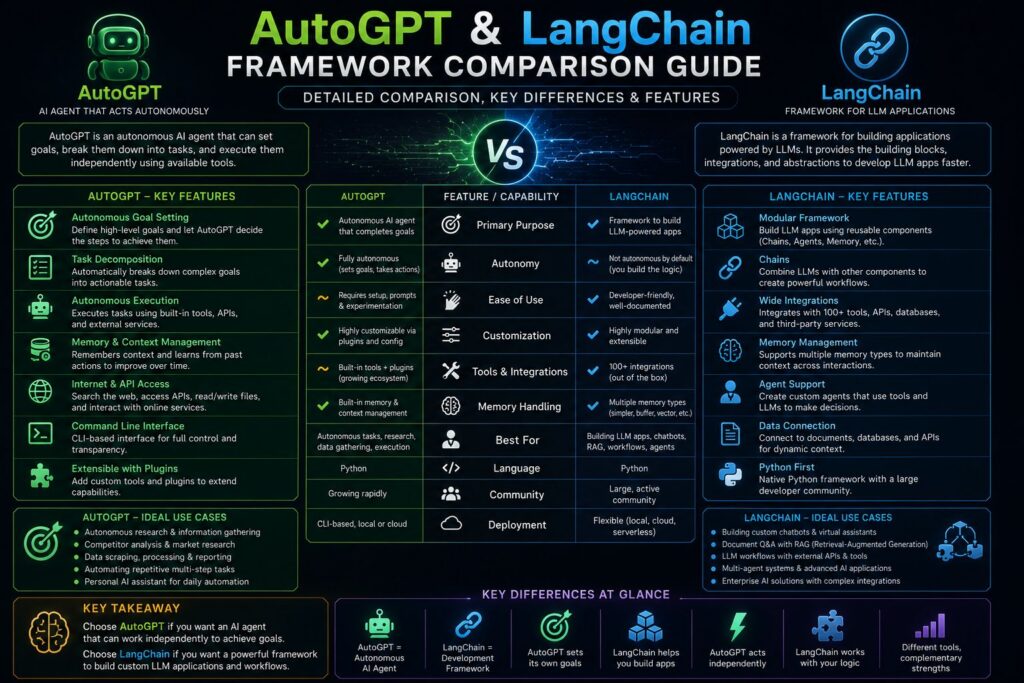
Quick AI Framework Overview
- LangChain provides developers with detailed control through modular chains, prompts, memory systems, and tool integrations — making it the preferred choice for production-grade AI applications.
- AutoGPT works independently — you set a goal, and it plans, executes, and iterates on its own, which is beneficial for prototyping but can be risky in production without safeguards.
- Cost is a hidden risk with AutoGPT Classic — its iteration loops can generate 3–5x more token usage than equivalent LangChain workflows, a detail most comparisons overlook.
- LangChain’s ecosystem is significantly more advanced, with LangSmith for observability, LangGraph for controllable agent workflows, and native integrations with Pinecone, FAISS, and Weaviate.
- You can actually use both together — and for some teams, that hybrid approach unlocks the best of autonomous prototyping and structured production deployment.
LangChain vs AutoGPT: Which Framework Should You Really Use?
Choose the wrong framework and you’ll either waste weeks rebuilding a fragile autonomous agent or ship a production app you can’t monitor, debug, or trust.
LangChain and AutoGPT were both designed to tackle the same basic issue – making large language models genuinely useful for actual tasks – but they each take a totally different approach to resolving that issue. LangChain provides you with a structured toolkit and tells you to “design the workflow.” AutoGPT, on the other hand, gives the agent control and tells it to “figure it out.” This guide is designed to help you understand which philosophy is best suited to your needs.
LangChain Empowers You, AutoGPT Lets You Sit Back
LangChain is a framework. It’s a series of components that you can piece together in any order you like. You’re in charge of everything: which prompt is activated, which tool is used, how memory is accessed, and what the final output is. This level of control is what makes LangChain so reliable. AutoGPT, meanwhile, is a self-governing system. You give it a broad goal and it takes care of the rest. It plans its own subtasks, uses tools, assesses the results, and keeps going until it thinks it’s done — or until it goes off the rails.
This is not a minor difference. It influences everything from your debugging experience to your cloud bill.
LangChain Takes the Cake for Production, AutoGPT Shines in Prototyping
There’s no contest in this department. LangChain’s structured, sequential execution model makes it a breeze to monitor, test, and optimize for real-world deployments. LangSmith — LangChain’s observability layer — allows you to track every chain call, examine intermediate outputs, and detect failures before they affect your users. AutoGPT Classic was not designed with production reliability as a priority. It’s an experimental playground that excels at demonstrating what autonomous agents can do, not at doing it reliably on a large scale.
Consider the following:
- LangChain is ideal for applications that interact with customers, data pipelines that handle sensitive information, and anything that requires predictable, auditable behavior.
- AutoGPT Classic is best suited for internal research, rapid prototyping, and exploring the capabilities of goal-driven agents without the need for human micromanagement.
- AutoGPT Platform is a newer visual workflow builder that bridges some of the production gap with no-code agent pipelines.
- LangGraph is LangChain’s own solution for controllable agent orchestration, offering structured loops and state management.
LangChain is almost always the safer starting point if you’re building for a team or a customer. If you’re exploring possibilities or building a proof of concept, AutoGPT will get you up and running faster.
AutoGPT Has 160k+ GitHub Stars, But LangChain Has the Ecosystem
AutoGPT went viral for a reason — watching an AI autonomously browse the web, write code, and self-correct feels like science fiction in real time. That hype translated to over 160,000 GitHub stars, making it one of the most starred AI repositories ever. But GitHub stars aren’t integrations, and they aren’t documentation. LangChain’s 80,000+ stars come attached to a mature ecosystem with hundreds of third-party integrations, active community support, enterprise adoption, and a growing suite of production tools that AutoGPT simply hasn’t caught up to yet.
Understanding LangChain and Its Functions
LangChain is an open-source framework that simplifies the process of creating applications that are driven by large language models. Instead of directly invoking an LLM and handling context, tools, and outputs yourself, LangChain provides you with a suite of components — chains, agents, memory modules, and tool connectors — that you can assemble into full workflows. This results in an application where the LLM is just one part of the system, not the whole thing.
Building Blocks: Chains, Prompts, Memory, and Tools
LangChain is built on the principle of modularity. A chain is a sequence of calls — whether to an LLM, a tool, or another chain — that processes input and delivers output. Prompt templates offer a neat way to parameterize your inputs, ensuring that logic and language are kept separate. Memory modules vary from a basic conversation buffer memory to vector-store-backed retrieval, allowing agents to recall context from previous interactions. Tools are external functions — such as search APIs, calculators, database connectors, and code interpreters — that the LLM can call upon during execution. For a deeper dive into AI platforms, explore the comparison of enterprise AI platforms.
The strength of this system lies in its composability. You can change a memory module without affecting your chain logic, or insert a different LLM provider without having to reconfigure your tool integrations. This adaptability is what allows LangChain to scale from a basic chatbot to a complicated multi-agent research pipeline.
Native Support for RAG With Pinecone, FAISS, and Weaviate
One of the most practical applications LangChain enhances is Retrieval-Augmented Generation (RAG). Rather than relying solely on an LLM’s training data, RAG allows your application to pull pertinent documents from a vector store at query time and inject them into the prompt. LangChain has built-in integrations with Pinecone, FAISS, Weaviate, Chroma, and several other vector databases, making it easy to construct knowledge-based applications without the need to create the retrieval infrastructure from the ground up. For a comparison of enterprise AI platforms, check out this AWS Bedrock and Google Vertex AI comparison.
LangSmith and LangGraph Enhance LangChain for Real-World Use
LangSmith is the platform LangChain uses for observability and evaluation. It logs every detail in your chain, including inputs, outputs, latency, and token usage, and presents them in a user-friendly dashboard for debugging. LangGraph enhances LangChain by adding stateful, cyclical agent workflows, giving developers the ability to control loops, branching logic, and coordination between multiple agents, which isn’t possible with standard chains. These tools combined fill in most of the gaps that would otherwise prevent LangChain from being effective in real-world settings.
Understanding AutoGPT and Its Functionality
AutoGPT is an independent AI agent framework that combines LLM calls, tool application, and self-assessment loops to achieve complex objectives with minimal human intervention. It was one of the initial projects to prove that GPT-4 could function not only as a tool for answering questions but also as an agent capable of independently planning and carrying out multi-step tasks. Since its introduction in early 2023, it has grown from a single autonomous agent to a larger platform that includes both a traditional CLI-based agent and a newer visual workflow builder.
The concept is straightforward yet revolutionary: AutoGPT eliminates the need for a developer to design each step, instead allowing the LLM to design its own execution plan. You set your objective, and the agent divides it into subtasks, chooses tools, carries out steps, reviews results, and iterates – all without you having to dictate every action.
AutoGPT Classic: Goal-Driven Autonomous Task Execution
AutoGPT Classic is the original command-line implementation. You configure it with API keys, define an agent name and role, set a goal in plain language, and let it run. The agent uses GPT-4 (or another supported model) to generate a task list, execute each task using available tools — web search, file read/write, code execution — and then self-evaluate before moving to the next step. It maintains a memory system that can use local storage or a vector database like Pinecone to persist information across its run.
AutoGPT Classic is a fantastic tool for developers who are interested in seeing what a fully autonomous agent can do when left to its own devices. The setup is quick and easy, but control is limited. It’s important to remember to set token limits before leaving it to complete an open-ended task.
The AutoGPT Platform: Visual Workflow Creator and Agent Marketplace
The AutoGPT Platform is the latest version of the project, created to make autonomous agent creation easier without the need for deep Python knowledge. It offers a visual, block-based interface for creating agent workflows, which is more similar to n8n or Zapier than to manually writing LangChain chains. The platform also includes an agent marketplace where users can share and deploy pre-made agents, expanding the ecosystem beyond what individual developers create from scratch.
Although it does bridge some of the functionality gaps between AutoGPT and tools ready for production, the platform is still in its growing phase. It provides an attractive compromise for teams desiring autonomous behavior without the sheer unpredictability of AutoGPT Classic, but it hasn’t yet reached the reliability level that LangChain has set for enterprise workflows.
Key Differences Between LangChain and AutoGPT
At first glance, LangChain and AutoGPT seem to be tackling the same issue. But when you delve a little deeper, you’ll see that they’re almost polar opposites in terms of who’s in control – the developer or the agent.
The table below outlines the most critical differences across the aspects that truly matter when selecting a framework for a real project.
Control Level: Step-by-Step Chains vs. Set-and-Forget Agents
LangChain allows the developer to control every part of the process. You specify the order of operations — which prompt is triggered first, what tool is used based on the output, how memory is accessed, and the format of the final response. Every part of the workflow is something you created, which means you can identify and resolve every potential failure point. This is what makes LangChain scalable and debuggable.
AutoGPT flips the script. Instead of inputting a series of tasks, you input a goal — something like “research the top five competitors in the electric vehicle market and summarize their pricing strategies” — and let the agent do the rest. It comes up with its own task list, decides which tools to use, determines whether each step was successful, and circles back if it thinks it needs to gather more information. You’re not controlling the execution; you’re observing it. This level of independence is truly awe-inspiring in demos and truly anxiety-inducing in production.
Cost Analysis: Controlled Spend vs. Endless Token Loops
When it comes to the financial implications of choosing between AutoGPT and LangChain, token cost is a key consideration. LangChain allows you to have full control over every LLM call in your chain. This means you can optimize to your heart’s content — you can cache repeated calls, direct simple queries to more cost-effective models like GPT-3.5, and set strict limits on context size. Your spend will increase proportionally with usage.
AutoGPT Classic’s iteration loops operate differently. The agent evaluates its own output and re-plans when it is not satisfied, so a single task can trigger dozens of LLM calls — often redundantly. AutoGPT Classic’s iteration loops can generate 3–5x more token usage than equivalent LangChain workflows for the same task outcome. Without hard token limits set upfront, an ambitious goal can use up an API budget in a single run. This is not theoretical — it is one of the most commonly reported pain points from developers who have transitioned from AutoGPT experimentation to production planning.
Production Readiness: LangChain’s Mature Tooling vs. AutoGPT’s Experimental Status
LangChain has been proven in enterprise environments. LangSmith provides full observability, which includes trace-level inspection of every chain call, latency tracking, token usage breakdowns, and evaluation tooling for regression testing your prompts. LangGraph adds structured state management for complex agent loops. These aren’t just optional extras; they’re essential features for any team deploying AI to real users. AutoGPT Classic was never designed for this context. It’s a research-grade tool that demonstrates what’s possible, not a production framework with reliability guarantees.
Learning Curve: Moderate for LangChain, Steep for AutoGPT Classic
LangChain is not without its learning curve, but it is well-documented and logically structured. Most developers with Python experience can build a functional RAG pipeline or tool-using agent within a day or two. The concepts — chains, memory, tools, agents — map cleanly onto familiar software design patterns. LangChain’s documentation, community tutorials, and active Discord make the ramp-up manageable.
AutoGPT Classic is more challenging to learn, but for a different reason. The initial setup is actually quick — clone the repository, insert your API keys, configure a .env file, and run. The difficulty lies in understanding why it behaves the way it does and how to effectively limit it. Because the agent generates its own plan, debugging unexpected behavior requires understanding both the LLM’s logic and the framework’s execution logic, which aren’t always clear. For those interested in exploring the differences in AI models, here’s a comparison of ChatGPT vs. Jasper AI that highlights features and pricing.
AutoGPT Platform makes it easier with its visual interface, but it has its own learning curve around how to structure agent workflows in a block-based environment instead of code.
| Feature | LangChain | AutoGPT Classic | AutoGPT Platform |
|---|---|---|---|
| Control Level | High — developer-defined chains | Low — goal-driven autonomy | Medium — visual workflow blocks |
| Token Cost Behavior | Predictable, optimizable | Can spiral 3–5x per task | Moderate, depends on workflow |
| Production Readiness | Mature (LangSmith, LangGraph) | Experimental | Maturing |
| Learning Curve | Moderate | Steep (debug-heavy) | Low-to-moderate |
| RAG Support | Native (Pinecone, FAISS, Weaviate) | Limited (Pinecone only) | Limited |
| Observability | Full (LangSmith tracing) | Minimal | Basic dashboard |
| GitHub Stars | 80,000+ | 160,000+ | Same repo |
| Best For | Production apps, enterprise | Research, prototyping | No-code agent building |
Where LangChain Outperforms AutoGPT
LangChain doesn’t win everywhere, but where it wins, the margin is significant. The clearest advantages show up the moment your project leaves the prototype stage and starts dealing with real users, real data, or real compliance requirements.
Handling Sensitive Data in Customer Applications
If your application deals with sensitive data such as personal information, financial records, health records, or any data that is subject to a compliance framework, predictability isn’t just nice to have – it’s necessary. LangChain’s explicit chain design ensures that you know exactly what data goes where, when the LLM sees it, and how outputs are handled. You can insert validation layers, redaction steps, and audit logging at specific points in the chain. AutoGPT’s autonomous planning makes this level of control difficult because the agent determines its own execution path, which can change from one run to the next.
Advanced Integrations With APIs, Databases, and Custom Tools
One of the main benefits of LangChain is its robust tool integration ecosystem. It comes with built-in connectors for SQL databases, REST APIs, Google Search, Wolfram Alpha, Wikipedia, vector stores, and many other services. These are all designed to plug directly into chains and agents. Additionally, creating custom tools is easy: simply wrap a Python function with LangChain’s tool decorator and it becomes available to any agent in your system. For applications that need to manage multiple external services reliably, LangChain’s structured approach to tool use is much more maintainable than incorporating the same integrations into AutoGPT’s less predictable execution loop.
Where AutoGPT Excels Over LangChain
AutoGPT shines in particular scenarios — especially when the speed of discovery is more important than dependability, or when you’re really interested in seeing what an agent can do without limiting its methods from the start. For a detailed comparison, you can explore ChatGPT vs. Jasper AI to understand different AI capabilities.
Quick Prototyping With Little Setup
Whether you need to showcase what an AI agent can do in a particular field — such as competitive analysis, content summarization, or data collection — AutoGPT Classic can help you achieve this in less than an hour. You don’t have to design a chain architecture or integrate any tools. All you have to do is define the goal, press run, and start observing. This speed-to-first-result benefit is incredibly useful for internal demonstrations, early product discovery, or research experiments.
Testing Fully Independent AI Actions
AutoGPT remains the premier practical platform for exploring how independent AI systems think, strategize, and bounce back from errors — as it reveals these actions in real time. If you’re a developer looking to comprehend where goal-oriented AI systems falter, what types of tasks trigger thinking cycles, or how self-assessment rules affect task achievement, AutoGPT Classic provides a real-time lab that LangChain’s more regulated setting just can’t duplicate. This knowledge is becoming more and more crucial as AI systems with agency move closer to widespread use.
Can LangChain and AutoGPT Be Used Together?
Absolutely — and for some teams, this combined approach is actually the most realistic way to proceed. The usual process is to use AutoGPT (or the AutoGPT Platform) during the initial exploration phase to quickly find out what an autonomous agent can do for a particular problem area, then move the validated workflows into LangChain for production deployment with the right observability, cost control, and reliability guarantees.
A more direct integration model is also possible: LangChain can serve as the structured backbone for specific subtask workflows, while an AutoGPT-style autonomous layer uses those LangChain chains as tools. This allows you to keep the parts of your system that need predictability firmly in LangChain’s controlled execution model while preserving the flexibility of autonomous planning at the higher orchestration level. It requires careful design, but teams building sophisticated multi-agent systems are increasingly treating the two frameworks as complementary rather than competing.
What are the main obstacles with each framework?
Every framework has its difficulties, and both LangChain and AutoGPT have issues that can take up your time if you don’t foresee them. The problems are different in nature — LangChain’s are usually architectural and operational, while AutoGPT’s are often behavioral and financial.
Both frameworks share a common issue: hallucination. LangChain and AutoGPT both struggle with LLMs producing outputs that are believable but incorrect. LangChain offers a partial solution by allowing you to add validation steps and output parsers at certain points in your chain. However, AutoGPT’s self-evaluation loop can actually make hallucinations worse — the agent may confidently continue based on a made-up intermediate result, constructing subsequent steps on a faulty foundation before you notice the mistake.
LangChain: Changes in API, Token Limits, and Abstraction Overhead
The fast pace of LangChain’s development is both a strength and a weakness. The framework has historically evolved so quickly that the API interfaces change between versions, and code that worked on LangChain 0.0.x may need significant refactoring on 0.1.x or 0.2.x. Teams running LangChain in production need to be careful about pinning dependency versions and budgeting time for migration work when upgrading. The abstraction layer that gives LangChain its flexibility also adds overhead — for very simple LLM applications, the framework can add unnecessary complexity compared to a direct API call.
AutoGPT Classic: Runaway Token Costs, Unpredictable Execution Loops, and Poor Error Recovery
- Runaway token costs — a single ambitious goal can trigger dozens of redundant LLM calls before the agent decides it’s satisfied, with no built-in mechanism to stop runaway spending
- Unpredictable execution loops — the agent may revisit completed subtasks, change plans mid-execution, or loop indefinitely on tasks it can’t resolve, with limited insight into why
- Poor error recovery — when a tool call fails or returns unexpected output, AutoGPT Classic often retries with minimal changes rather than significantly adapting its approach
- Context window exhaustion — long autonomous runs accumulate conversation history that can exceed the model’s context window, causing the agent to lose track of previous decisions
The token cost problem is especially noteworthy because it surprises developers the first time they encounter it. A task that takes a human analyst twenty minutes can translate into forty or fifty sequential GPT-4 calls as AutoGPT Classic plans, executes, self-evaluates, re-plans, and retries. At GPT-4 pricing, this can add up more quickly than most developers anticipate during their first real-world test run.
The other structural weakness is error recovery. LangChain allows you to wrap specific chain steps in try-except logic, define fallback chains for failure cases, and clearly surface error states in LangSmith traces. AutoGPT Classic’s error handling is largely built into the agent’s own reasoning — which means when the LLM misunderstands a failure, the recovery strategy is equally misguided. This results in an agent that confidently retries a broken approach rather than escalating or stopping.
While AutoGPT Classic isn’t completely unworkable due to these issues, they do make it unfit for situations where cost, reliability, and predictability are important. These trade-offs are acceptable for internal research runs where you can manually monitor the agent and kill the process if it goes off track. However, for anything customer-facing or budget-constrained, they’re dealbreakers without a lot of additional engineering work on the framework.
Validation is Necessary to Avoid Hallucinations in Both Frameworks
LangChain and AutoGPT both suffer from the hallucination problem of the underlying LLMs they use, as neither framework inherently grounds facts. The way each framework allows you to address this problem architecturally is where they differ. LangChain provides explicit insertion points for validation: output parsers that ensure schema compliance, retrieval steps that ground responses in actual documents, and chain branching logic that can direct outputs with low confidence to a queue for human review. While these are not automatic, the framework makes them easy to implement.
AutoGPT’s self-evaluation loop is often misinterpreted as a safeguard against hallucination, but it’s not. When the agent goes over its own output, it’s using the same LLM that generated the output initially. This means that a hallucination that’s produced with confidence will pass the self-evaluation as easily as a correct answer. In either framework, proper validation requires external ground truth. This could be retrieval-augmented context, structured output schemas, or human-in-the-loop checkpoints at critical decision nodes.
Choosing the Right Framework in 2025
The right framework isn’t the one that has the most technical bells and whistles. It’s the one that fits your specific needs. Ask yourself three questions to start: How much control do you need over execution? How much can you afford to spend per task run? And what is your team’s preferred way to build?
Define Your Control Needs
LangChain is the way to go if your application processes sensitive information, caters to external users, or operates within a regulatory framework. With its explicit chain design, you have full control over every data touchpoint, and LangSmith provides the audit trail to back it up. If you’re creating an internal research tool, a personal automation, or a proof-of-concept to validate a business idea, AutoGPT’s autonomous execution model will get you to a working demo faster, without the extra architectural work.
Consider Your Budget and Token Cost Exposure
AutoGPT Classic without any hard token limits can be a financial risk in production. Before you commit to it for any actual workload, you should calculate your worst-case cost scenario. This means you should assume the agent takes the maximum possible number of steps to complete your target task. Then, multiply this by GPT-4 input and output pricing. After this, you can decide whether this maximum cost is acceptable. LangChain’s explicit chain architecture allows you to make the same calculation with much more confidence. This is because you know exactly which steps call the LLM and how often. If your budget is set or your task volume is high, LangChain’s cost predictability is a structural advantage that increases over time.
Choose the Tool that Suits Your Team’s Working Style
Every team has its own unique way of building things, and the framework that matches your team’s way of thinking will be more effective than a theoretically superior one that goes against your instincts. LangChain is a great fit for developers who prefer to think in terms of data pipelines. If you’re used to designing input-output flows, composing functions, and thinking about state in an explicit way, you’ll find LangChain’s architecture intuitive. On the other hand, the AutoGPT Platform is designed for teams who prefer to think in terms of goals and outcomes. If you’d rather tell the system what you want it to do and let it figure out the steps, you’ll appreciate its visual builder and autonomous execution model.
If your project involves intricate agent loops, it may be beneficial to examine LangGraph separately from the typical LangChain. LangGraph introduces structured state machines to the LangChain environment, enabling you to create agents that can cycle and branch while maintaining the control and observability that make LangChain suitable for production. For teams constructing complex multi-step agents, LangGraph frequently strikes the perfect balance between the control of LangChain and the flexibility of enterprise AI platforms.
A common strategy that is effective for the majority of teams is to utilize AutoGPT or the AutoGPT Platform to swiftly examine the problem area. This allows you to identify the agent’s preferred subtasks, the most useful tools, and consistent failure points. You can then use these insights to thoughtfully construct a LangChain application that incorporates the successful patterns and protects against the failure modes you discovered during your exploration.
Here is a list of the features and differences between AutoGPT and LangChain:
- LangChain with LangSmith is ideal if you need compliance and auditability.
- AutoGPT Classic is perfect if you need rapid prototyping with minimal setup.
- AutoGPT Platform is the best choice if you need a no-code agent building for a non-technical team.
- LangGraph is the go-to if you need complex stateful agent loops in production.
- If you need the best of both, you can prototype with AutoGPT and productionize with LangChain.
LangChain is Currently the Safer Choice for Most Developers
While AutoGPT provides an exciting glimpse into the future of autonomous AI agents, LangChain is the more reliable choice for developers today. With its mature ecosystem, production-grade observability through LangSmith, flexible memory and retrieval integrations, and explicit control model, LangChain is trusted by developers to handle real workloads, real users, and real budgets. Although AutoGPT is a valuable tool for exploration and prototyping, when it comes to building something that runs reliably, scales predictably, and doesn’t surprise you with a five-figure API bill, LangChain is the more worthwhile investment.
Common Questions
These are the typical questions developers have when deciding between LangChain and AutoGPT, answered directly from practical experience with each framework.
How Do LangChain and AutoGPT Differ?
LangChain is a developer framework that allows you to build structured LLM workflows. You have to explicitly design the execution path using chains, memory modules, and tool integrations. On the other hand, AutoGPT is an autonomous agent system. You just need to set a high-level goal and the agent will plan, execute, and self-evaluate its own task sequence without needing step-by-step direction from you. LangChain gives you control while AutoGPT gives you autonomy. This is the main difference that drives almost all the practical differences between the two frameworks.
Which Framework Is More Suitable for Production Applications?
LangChain is much more suitable for production. Its explicit chain architecture ensures predictable and debuggable behavior, LangSmith offers complete observability with trace-level inspection of every call, and the framework has been proven across enterprise deployments in ways that AutoGPT Classic has not. LangChain also allows for effective cost control — you can cache calls, direct queries to less expensive models, and set strict limits at certain chain steps.
AutoGPT Classic wasn’t built with production reliability in mind. The autonomous execution model it uses makes it hard to ensure consistent behavior, it has a high token cost exposure unless additional engineering guardrails are put in place, and it uses the same LLM for error recovery that caused the error to begin with. The AutoGPT Platform is addressing some of these issues, but it’s still not as mature as LangChain’s production ecosystem.
What is the Cost of Unregulated AutoGPT?
When comparing AutoGPT Classic’s iteration loops to equivalent LangChain workflows, the former can generate 3–5 times more token usage for the same task outcome. A goal that would typically require twenty human-equivalent steps can trigger between forty and fifty LLM calls as the agent goes through the process of planning, executing, self-evaluating, re-planning, and retrying. The price of a single complex run without token limits can be surprisingly high at GPT-4 pricing. It is always recommended to set maximum iteration limits and token budgets before running AutoGPT Classic on any task that has not been extensively tested in a controlled environment.
Setting Up AutoGPT vs LangChain
AutoGPT Classic is quicker to get up and running. All you have to do is clone the repository, configure your API keys in a .env file, and you’re good to go. Most developers can get it working in less than half an hour. LangChain, on the other hand, requires more preparation because you’re creating a workflow rather than just setting a target for an agent. However, the time spent designing pays off: LangChain applications are much easier to debug, modify, and expand than equivalent AutoGPT implementations because each component is something you intentionally added and can inspect directly.
Will LangChain and AutoGPT still be useful as AI models become smaller and more specific?
Both frameworks were developed with the idea that orchestration is beneficial – that the combination of LLM calls with memory, tools, and structured workflows results in better results than a single model call alone. This idea applies whether the underlying models are large or small, general or specific. As smaller, faster, domain-specific models become more capable, frameworks like LangChain become more valuable because they make it easy to route different tasks to different models based on cost, latency, and capability requirements.
Whether AutoGPT’s relevance path is dependent on the broader vision of fully autonomous agents gaining practical traction. If goal-driven agents become a mainstream application pattern, which the AutoGPT Platform is actively betting on, then AutoGPT’s head start in that paradigm becomes a meaningful advantage. The visual agent builder and marketplace model positions it well for non-developer adoption in a way LangChain’s code-first approach doesn’t naturally reach.
The future will likely see a convergence of these two systems. LangGraph is already steering LangChain towards a more autonomous, stateful agent behavior. Meanwhile, the AutoGPT Platform is shifting towards more structured, controllable workflows. The line separating a “structured framework” from an “autonomous agent system” will probably become much less clear in the coming years as each system incorporates the strengths of the other.
AutoGPT and LangChain are two prominent frameworks in the AI landscape, each offering unique features and capabilities. AutoGPT is known for its advanced natural language processing abilities, while LangChain excels in its modular approach to building AI applications. For businesses looking to deploy AI solutions, understanding the comparison of enterprise AI platforms can be crucial in making informed decisions. Both frameworks have their strengths, and choosing the right one depends on specific project requirements and goals.