

Article At A Glance
- OpenAI officially retired 6 older Codex models on April 14, 2026, removing them entirely from the Codex platform for ChatGPT sign-in users.
- The retired models stopped appearing in the model picker as early as April 7, giving developers a short window to prepare.
- Developers who still need the older models can continue accessing them by using their own API key or configuring a custom model provider.
- Five newer models now power Codex after the retirement, including gpt-5.3-codex-spark — but that one is reserved exclusively for Pro users.
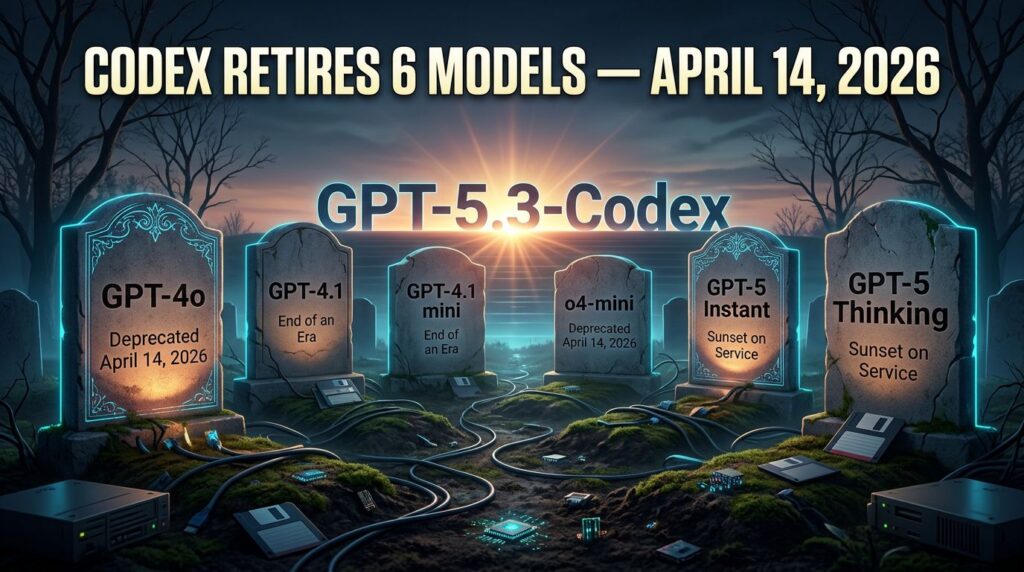
- This retirement is part of a broader OpenAI model cleanup that already pulled GPT-4o, GPT-4.1, and o4-mini from ChatGPT back in February 2026.
OpenAI just cut six Codex models in one move — and if you weren’t paying attention, your workflow may already be affected.
The announcement came through the official Codex changelog, confirming that six older models would be retired from Codex for ChatGPT sign-in users starting April 14, 2026. This isn’t a deprecation warning with months of runway — it’s a hard cutoff. The models disappeared from the model picker on April 7, and by April 14, they were fully removed for anyone signing into Codex through their ChatGPT account. For developers and power users who’ve been building around Codex, understanding exactly what’s gone and what’s still standing is critical right now.
Tools and platforms that track the fast-moving AI model landscape — including resources focused on AI coding assistants — have been closely following OpenAI’s model lifecycle decisions as the company accelerates its consolidation strategy heading into mid-2026.
6 Codex Models Are Gone as of April 14, 2026
The retirement affects a specific slice of the Codex model lineup — primarily the older gpt-5.1 and gpt-5.2 generation models. These were the workhorses of Codex during its earlier rollout phase, but OpenAI has now moved on.
The Exact Models Being Retired
Here are the six models that have been removed from Codex for ChatGPT sign-in users as of April 14, 2026:
- gpt-5.2-codex
- gpt-5.1-codex-mini
- gpt-5.1-codex-max
- gpt-5.1-codex
- gpt-5.1
- gpt-5
The removal timeline was two-stage: the models were hidden from the model picker starting April 7, and then fully decommissioned on April 14 for ChatGPT-authenticated Codex users.
Why OpenAI Is Cutting These Models
OpenAI’s pattern here is consistent — retire older model versions as newer, more capable ones become stable enough to replace them. The gpt-5.3 and gpt-5.4 generation models are now considered the active lineup, and maintaining parallel access to six legacy versions adds infrastructure overhead without meaningful benefit to most users.
This also follows OpenAI’s February 2026 decision to remove GPT-5 Instant and Thinking variants, GPT-4o, GPT-4.1, GPT-4.1 mini, and o4-mini from ChatGPT. The April 14 Codex retirement is the second major model cleanup in under two months, signaling that OpenAI is aggressively streamlining its model catalog across both consumer and developer surfaces.
Timeline Snapshot:
📅 April 7, 2026 — Retired models removed from Codex model picker
📅 April 14, 2026 — Full removal from Codex for ChatGPT sign-in users
📅 February 2026 — GPT-4o, GPT-4.1, GPT-4.1 mini, o4-mini removed from ChatGPT
📅 After April 14 — Legacy access still possible via own API key or custom model provider
1. gpt-5
gpt-5 was the base model in this retired group — not to be confused with the full GPT-5 family still active elsewhere. In the context of Codex, this was an early-generation integration that served as the foundation before more specialized coding variants were layered on top of it. Its removal was expected given how far the Codex-specific fine-tuning has advanced in the gpt-5.3 and gpt-5.4 series.
2. gpt-5.1
gpt-5.1 represented the first significant iteration beyond the base gpt-5 in Codex, offering improved instruction-following for coding tasks. It was an incremental step rather than a major architectural leap, which is largely why it’s been swept up in this cleanup alongside the more specialized variants built on top of it. For more on AI model developments, explore Gemma 4 open models by Google.
3. gpt-5.1-codex
gpt-5.1-codex was the first dedicated Codex-optimized variant in the 5.1 generation. This model was specifically tuned for agentic coding tasks — things like multi-file edits, terminal command execution, and test writing inside sandboxed environments. It was a meaningful step forward from gpt-5.1 for pure development use cases.
However, the gap between gpt-5.1-codex and what gpt-5.3-codex and gpt-5.4 now deliver has widened considerably. Keeping it in the active lineup no longer makes sense when newer models handle the same tasks with higher accuracy and better context handling.
gpt-5.1 Generation — Retired Models at a Glance
Model Type Status gpt-5.1 Base generation model ❌ Retired April 14 gpt-5.1-codex Codex-optimized variant ❌ Retired April 14 gpt-5.1-codex-mini Lightweight coding model ❌ Retired April 14 gpt-5.1-codex-max High-capacity coding model ❌ Retired April 14
4. gpt-5.1-codex-mini
gpt-5.1-codex-mini was the lightweight option in the 5.1 Codex family — designed for faster responses and lower compute cost, making it useful for simpler coding tasks, autocomplete-style interactions, and scenarios where speed mattered more than depth. With gpt-5.4-mini now in the active lineup, the mini-tier is still well-represented; it’s just moved to a newer, stronger base.
5. gpt-5.1-codex-max
gpt-5.1-codex-max sat at the opposite end of the 5.1 spectrum — the highest-capacity variant in that generation, built for complex, long-context coding tasks. It was likely the model of choice for developers working on large codebases or multi-step agentic workflows during Codex’s earlier rollout. Its retirement makes room for the gpt-5.3 and gpt-5.4 models, which bring that same high-capacity capability with more recent training and better performance benchmarks.
6. gpt-5.2-codex
gpt-5.2-codex was the most recent model in the retired batch — and arguably the one most developers were still actively using before this announcement. It sat in the 5.2 generation, one step ahead of the 5.1 variants, and offered noticeably improved code generation quality for agentic tasks inside the Codex environment. Its retirement is the clearest signal that OpenAI considers the 5.3 and 5.4 generation models mature enough to fully take over.
What Replaces the Retired Models in Codex
The good news is that OpenAI isn’t leaving developers with nothing. Five models remain active in Codex after April 14, covering the full range from lightweight to high-performance use cases. The active lineup is newer, better trained, and in most benchmarks outperforms the models being retired.
The 5 Models Still Supported After April 14
Here’s what’s still available in Codex for ChatGPT sign-in users going forward:
- gpt-5.4 — The current flagship Codex model for high-complexity coding tasks
- gpt-5.4-mini — The lightweight, faster-response option in the active lineup
- gpt-5.3-codex — A proven Codex-optimized model, one generation behind the latest
- gpt-5.3-codex-spark — A specialized variant available exclusively to Pro users
- gpt-5.2 — The base 5.2 generation model, retained despite the retirement of its Codex-specific sibling
gpt-5.3-codex-spark Is Pro-Only
gpt-5.3-codex-spark is notable because it’s the only model in the active Codex lineup that sits behind a paywall tier. It’s exclusively available to ChatGPT Pro subscribers, which positions it as a premium option for developers who need something beyond what gpt-5.3-codex and gpt-5.4 offer in standard access. For a broader comparison, you might be interested in this enterprise AI solutions comparison.
The exact capability differences between gpt-5.3-codex-spark and gpt-5.3-codex haven’t been fully detailed publicly, but the Pro-only restriction suggests it either has higher rate limits, extended context handling, or performance characteristics that OpenAI is reserving for its top-tier subscribers. If you’re doing heavy agentic coding work and already on Pro, it’s worth testing against gpt-5.4 to see which fits your workflow better.
What Developers Should Do Right Now
If your Codex setup relied on any of the six retired models, the April 7 disappearance from the model picker was your first signal to act. By April 14, those models stopped working entirely for ChatGPT sign-in users. The practical steps depend on whether you need to preserve access to the old models or are ready to migrate forward.
For most developers, migrating to gpt-5.3-codex or gpt-5.4 is the right move. These models handle the same agentic coding tasks — multi-file edits, terminal execution, test generation — with better output quality. The transition is unlikely to require significant workflow changes beyond swapping the model selection.
Use Your Own API Key to Keep Older Models
If you have a specific reason to keep using one of the retired models — a production pipeline that hasn’t been validated against newer outputs, for example — OpenAI has provided a path. Developers can connect Codex using their own API key rather than signing in through their ChatGPT account. This method gives you direct control over which model you call, including older versions that are still accessible via the API even after being removed from the ChatGPT-based Codex interface.
This is an important distinction: the retirement applies specifically to Codex with ChatGPT sign-in. API-based access operates under a different lifecycle, and models deprecated from the consumer-facing Codex surface may still be callable directly through the API for a period of time. Check the OpenAI API deprecation schedule separately from the Codex changelog to confirm availability of specific model versions.
How to Configure a Custom Model Provider in Codex
Beyond using your own OpenAI API key, Codex also supports configuring a custom model provider entirely — meaning you can point Codex at a different model backend if needed. This option is particularly relevant for enterprise teams that have negotiated specific API access agreements or are running fine-tuned models on their own infrastructure. OpenAI has made this configuration available as a fallback for exactly these kinds of transition scenarios.
This Is Part of a Bigger OpenAI Cleanup
The April 14 Codex retirement doesn’t exist in isolation. OpenAI has been systematically trimming its model catalog across both ChatGPT and its developer platforms, and the pace has accelerated significantly in early 2026. What’s happening with Codex is the developer-facing chapter of a broader consolidation story.
GPT-4o, GPT-4.1, and o4-mini Were Also Cut From ChatGPT in February 2026
Just weeks before the Codex retirement, OpenAI removed several high-profile models from ChatGPT in February 2026 — including GPT-5 Instant and Thinking variants, GPT-4o, GPT-4.1, GPT-4.1 mini, and OpenAI o4-mini. That move affected the consumer ChatGPT experience directly, while the April 14 action targets the developer-focused Codex platform. Together, these two cleanup rounds represent a significant reduction in the total number of active models OpenAI is maintaining in parallel, pointing toward a leaner, more focused model strategy for the rest of 2026.
Codex Pricing Also Changed Recently
The model retirement isn’t the only significant change hitting Codex users in this period. OpenAI has also adjusted its pricing structure for Codex, introducing more flexible seat options and lowering the cost barrier for business-level access. For teams evaluating whether to commit to Codex long-term, these pricing shifts matter just as much as the model lineup changes.
Pay-As-You-Go Seats Now Available for Business and Enterprise
OpenAI introduced pay-as-you-go seat pricing for both Business and Enterprise Codex plans, giving teams more flexibility instead of being locked into rigid annual commitments upfront. This is particularly useful for organizations that want to pilot Codex across a smaller group before scaling, or for companies with fluctuating developer headcounts. The move signals OpenAI’s intent to lower the friction for larger organizations adopting Codex as a core part of their development workflow.
ChatGPT Business Annual Price Dropped From $25 to $20 Per Seat
The annual per-seat price for ChatGPT Business dropped from $25 to $20 per month when billed annually. That’s a 20% reduction, which adds up meaningfully at scale — a team of 50 developers saves $3,000 per year at that rate. The pricing change applies to annual subscriptions and positions OpenAI more competitively against other AI coding assistant platforms that have been aggressively pricing their enterprise tiers throughout early 2026.
For teams already on the annual Business plan, it’s worth confirming with OpenAI directly whether the new rate applies automatically at renewal or requires a plan adjustment. The combination of lower per-seat pricing and pay-as-you-go flexibility represents a meaningful shift in how OpenAI is approaching enterprise adoption — making entry cheaper and commitment more optional. For a deeper understanding of enterprise services, consider this comparison of Azure AI vs. IBM Watson.
Frequently Asked Questions
The April 14 Codex model retirement has generated a lot of questions from developers who rely on these models daily. Below are the most common questions — answered directly, without the noise.
Which Codex models did OpenAI retire on April 14, 2026?
OpenAI retired six models from Codex for ChatGPT sign-in users on April 14, 2026. The retired models are gpt-5.2-codex, gpt-5.1-codex-mini, gpt-5.1-codex-max, gpt-5.1-codex, gpt-5.1, and gpt-5.
These models were first hidden from the Codex model picker starting April 7, 2026, giving users a one-week window to notice the change before full removal on April 14. The retirement applies specifically to users accessing Codex through their ChatGPT account — it does not automatically affect API-based access under a separate key.
Can developers still access the retired Codex models after April 14?
Yes — but only through a workaround. Developers who need continued access to the retired models can do so by connecting Codex with their own OpenAI API key instead of signing in through ChatGPT, or by configuring a custom model provider. This bypasses the ChatGPT sign-in restriction and allows direct model selection. However, this depends on the specific model still being available via the API, which follows a separate deprecation schedule from the Codex consumer surface. For a comparison of AI services, you can check out this comparison of Azure AI vs IBM Watson.
Which Codex models are still available after the April 14 retirement?
Five models remain active in Codex for ChatGPT sign-in users after April 14: gpt-5.4, gpt-5.4-mini, gpt-5.3-codex, gpt-5.3-codex-spark, and gpt-5.2. These represent the current active Codex lineup and cover a range of use cases from lightweight, fast-response tasks to high-complexity agentic coding workflows.
For most developers, gpt-5.4 or gpt-5.3-codex will be the direct functional replacement for whatever they were running in the 5.1 or 5.2 Codex generation. The newer models handle the same core tasks — multi-file edits, test generation, terminal execution — with improved output quality.
Is gpt-5.3-codex-spark available to all ChatGPT users?
No. gpt-5.3-codex-spark is exclusively available to ChatGPT Pro subscribers. It is the only model in the current active Codex lineup that sits behind a tier restriction, making it a premium option within an already premium product.
If you’re on a Business or Enterprise plan and don’t have Pro access, you’ll be working with the remaining four active models. For most professional coding workflows, gpt-5.4 offers comparable depth, so the Pro exclusivity of Spark is most relevant to power users pushing the boundaries of what agentic coding assistants can do.
Why is OpenAI retiring these older Codex models?
OpenAI’s core reason is model lifecycle management — as newer, more capable models become stable, maintaining parallel access to older generations creates infrastructure overhead without delivering meaningful value to the majority of users. The gpt-5.3 and gpt-5.4 generation models outperform the retired 5.1 and 5.2 variants across the tasks Codex is built for.
There’s also a broader strategic pattern at play. OpenAI has been consolidating its model catalog aggressively in early 2026, having already removed GPT-4o, GPT-4.1, GPT-4.1 mini, and o4-mini from ChatGPT in February 2026. The Codex retirement is the developer-platform chapter of that same cleanup effort — a deliberate move toward a leaner, more maintainable model lineup.