
Azure AI vs IBM Watson: Article At A Glance
- Azure AI scores 8.8 out of 10 on TrustRadius while IBM Watson Discovery scores 9.2 — but raw ratings don’t tell the whole story for enterprise decision-makers.
- IBM Watson has a proven edge in heavily regulated industries like healthcare and finance, while Azure AI dominates when deep Microsoft ecosystem integration matters.
- IBM watsonx.ai represents a major evolution beyond the classic Watson platform — and understanding that difference could change which platform you choose.
- Azure AI’s pay-as-you-go pricing model gives it a significant cost flexibility advantage over IBM Watson’s enterprise licensing structure.
- SuperAGI helps businesses navigate AI platform decisions and enterprise deployments, cutting through the noise to find what actually works.
Choosing between Azure AI and IBM Watson isn’t just a tech decision — it’s a strategic one that will shape how your business competes for years.
Both platforms are genuinely powerful, and both have earned their place at the top of the enterprise AI market. But they’re built with different philosophies, different strengths, and different ideal customers in mind. Picking the wrong one doesn’t just cost money — it costs momentum. Understanding the real differences between these two platforms is exactly the kind of decision-support that organizations like SuperAGI specialize in, helping businesses cut through marketing noise and deploy AI that actually delivers results.
Two Giants, One Decision: What You Need to Know First
Microsoft Azure AI and IBM Watson represent two of the most mature enterprise AI ecosystems available today. Azure AI is Microsoft’s broad suite of artificial intelligence services built on top of the Azure cloud platform, ranging from vision and speech tools to the powerful Azure OpenAI Service. IBM Watson, now evolving under the IBM watsonx brand, is IBM’s AI platform with deep roots in natural language processing, data governance, and industry-specific AI applications.
These aren’t products you simply plug in and walk away from. Both require real implementation effort, organizational buy-in, and ongoing management. The question isn’t which one is technically superior in every category — it’s which one is the right fit for your specific business context.
Azure AI Bot Service Scores 8.8 vs IBM Watson Discovery’s 9.2 on TrustRadius
According to TrustRadius, Azure AI Bot Service holds a likelihood-to-recommend score of 8.8 out of 10, while IBM Watson Discovery scores 9.2 out of 10. On G2, Azure OpenAI Service holds a 4.6 out of 5 star rating based on 54 reviews, compared to IBM watsonx.ai’s 4.4 out of 5 from 143 reviews. These numbers signal strong satisfaction across both platforms, but they also reflect different user bases and use cases — making direct comparison a nuanced exercise.
Which Platform Fits Your Business Size and Budget
Budget and organizational size play a massive role in this decision. Azure AI’s pay-as-you-go structure makes it more accessible for mid-market companies and fast-scaling startups that need flexibility. IBM Watson’s enterprise licensing model is better suited to large organizations with predictable, high-volume AI workloads where a negotiated contract makes financial sense.
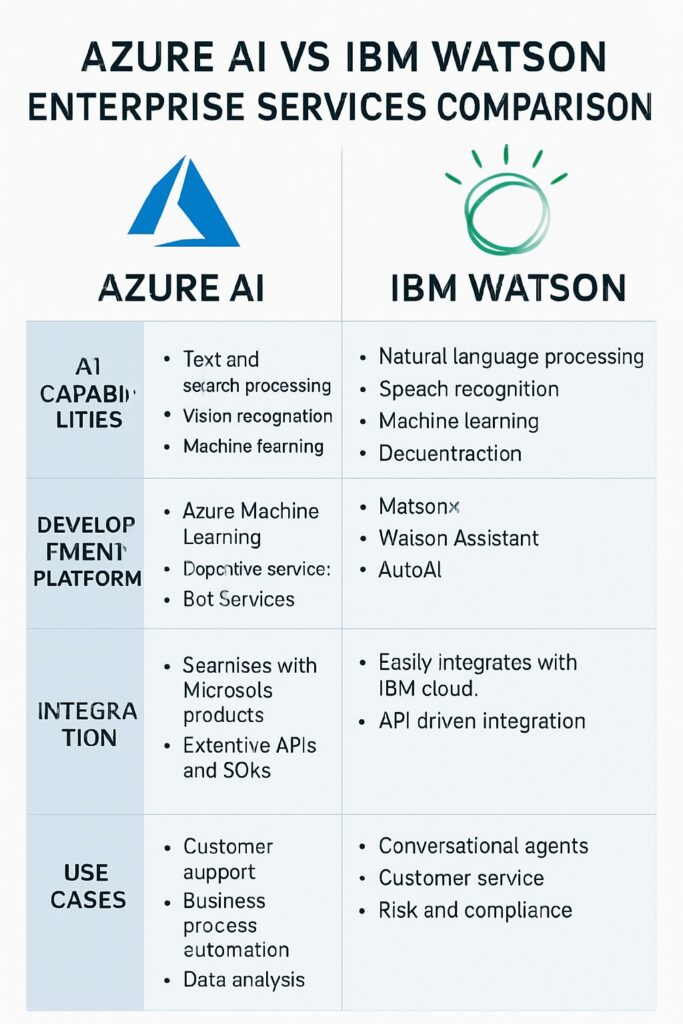
Here’s a quick snapshot of how the two platforms stack up at a high level before diving deeper:
| Criteria | Azure AI | IBM Watson / watsonx.ai |
|---|---|---|
| TrustRadius Score | 8.8 / 10 | 9.2 / 10 |
| G2 Star Rating | 4.6 / 5 (54 reviews) | 4.4 / 5 (143 reviews) |
| Pricing Model | Pay-as-you-go | Enterprise licensing |
| Best Ecosystem Fit | Microsoft stack | Hybrid & multi-cloud |
| Industry Strength | Cross-industry | Healthcare, Finance, Legal |
| Setup Fee | None | Varies by contract |
What Azure AI Actually Offers Enterprises
Azure AI is not a single product — it’s an expansive ecosystem of AI services that spans everything from pre-built cognitive APIs to fully custom machine learning pipelines. For enterprises already running on Microsoft infrastructure, it functions as a natural extension of tools they already use. For a deeper dive into how these tools compare with other AI solutions, you can explore this comparison of Microsoft Copilot and ChatGPT.
Core AI Services: Vision, Language, and Decision Tools
Azure AI is organized around several flagship service categories. Azure Cognitive Services provides pre-built APIs that cover computer vision, speech recognition, language understanding, and decision-making capabilities — all accessible without needing deep machine learning expertise. Azure Machine Learning provides the infrastructure for data scientists to build, train, and deploy custom models at scale.
What makes this stack compelling for enterprise users is the breadth. A single Azure subscription can support an automated document processing workflow, a customer-facing chatbot, a fraud detection model, and a demand forecasting engine — all under one billing account and one security framework.
- Azure Computer Vision: Image analysis, OCR, and spatial analysis for physical environments
- Azure Language Service: Named entity recognition, sentiment analysis, summarization, and translation
- Azure Speech Service: Real-time speech-to-text, text-to-speech, and speaker recognition
- Azure Bot Service: End-to-end chatbot development with multi-channel deployment support
- Azure Machine Learning: MLOps pipelines, AutoML, and model explainability tools
- Azure Form Recognizer: Intelligent document processing for structured data extraction
This breadth means enterprises rarely need to look outside Azure to build complete, production-ready AI solutions.
Azure OpenAI Service and GPT-4 Integration
One of Azure AI’s most significant advantages right now is its exclusive enterprise access to OpenAI models, including GPT-4, through the Azure OpenAI Service. This gives enterprises access to state-of-the-art large language model capabilities — including text generation, code completion, and semantic search — within Azure’s enterprise security and compliance wrapper. This is a capability IBM Watson simply cannot match in its current form.
Enterprise Security and Compliance Built Into Azure
Security is non-negotiable for enterprise AI deployments, and Azure delivers here with a robust framework. Azure AI services are covered under Microsoft’s comprehensive compliance certifications, including ISO 27001, SOC 2, HIPAA, and FedRAMP — making them viable for regulated industries including healthcare, government, and financial services.
Azure’s role-based access control, private endpoints, virtual network integration, and customer-managed encryption keys give IT and security teams granular control over how AI workloads are deployed and who can access model outputs and training data. For organizations operating in multiple geographies, Azure’s data residency controls are an important feature that allows data to stay within specific regions. For more on AI security concerns, you might be interested in Anthropic’s Mythos model security concerns.
Microsoft also layers in responsible AI tooling through Azure AI Content Safety and the Azure Responsible AI dashboard, giving enterprises tools to detect bias, monitor model fairness, and flag harmful outputs — critical features as regulatory pressure on AI systems increases globally.
Deployment Flexibility: Cloud, On-Premises, and Hybrid
Azure AI supports cloud-native deployment as its primary model, but enterprises with on-premises requirements can leverage Azure Arc to extend AI services to edge and on-prem environments. This hybrid capability is increasingly important for organizations in industries where data cannot leave internal infrastructure.
What IBM Watson Actually Offers Enterprises
IBM Watson has been in the enterprise AI market longer than most of its competitors, and that history shows in the depth of its industry-specific tooling. Watson’s roots in natural language processing date back to its famous Jeopardy! victory in 2011, but the platform has evolved dramatically since then — particularly with the launch of the IBM watsonx platform.
Today, IBM’s AI offering is best understood as two overlapping layers: the classic Watson products like Watson Assistant and Watson Discovery, and the newer watsonx suite which includes watsonx.ai, watsonx.data, and watsonx.governance. Understanding this distinction matters when evaluating IBM’s current capabilities versus what many businesses remember Watson being.
Watson’s NLP and Conversational AI Capabilities
Watson Assistant remains one of the most capable enterprise conversational AI tools on the market, particularly for complex, domain-specific deployments. Unlike general-purpose chatbot frameworks, Watson Assistant is built to handle sophisticated dialogue management, intent recognition across multiple languages, and seamless integration with enterprise backend systems like Salesforce, ServiceNow, and SAP.
Watson Discovery adds a layer of intelligent document understanding, enabling enterprises to extract insights from large unstructured document repositories — contracts, research reports, customer feedback, and compliance documents. Its NLP scoring of 9.2 out of 10 on TrustRadius reflects strong user confidence in these capabilities, particularly in industries where language-heavy workflows dominate.
IBM watsonx.ai: The Next Generation AI Platform
IBM watsonx.ai is IBM’s answer to the generative AI wave, providing enterprises with access to foundation models — including IBM’s own Granite models — alongside support for open-source models like Llama 2. Unlike Azure OpenAI Service, which is tied to OpenAI’s proprietary model stack, watsonx.ai emphasizes model choice, transparency, and the ability to fine-tune models on proprietary enterprise data with full governance controls in place. For enterprises that are wary of vendor lock-in at the model layer, this is a meaningful differentiator. For a detailed comparison of enterprise AI solutions, you can explore other options available in the market.
Watson’s Strength in Regulated Industries
IBM Watson has built its strongest reputation in industries where compliance, auditability, and data sensitivity are non-negotiable. Healthcare organizations use Watson to power clinical decision support, patient triage automation, and medical record analysis. Financial institutions rely on Watson’s NLP capabilities for contract analysis, regulatory compliance monitoring, and fraud detection workflows. The platform’s long history in these sectors means IBM has pre-built industry accelerators, compliance documentation, and implementation playbooks specifically tailored to regulated enterprise environments.
Head-to-Head Feature Comparison
When you strip away the marketing language, both platforms are competing for the same enterprise dollar — but they approach core AI capabilities from meaningfully different angles. Azure AI leans into breadth, integration depth with the Microsoft ecosystem, and access to cutting-edge generative AI models. IBM Watson leans into governance, industry specialization, and enterprise-grade NLP that has been hardened through years of real-world deployment in complex organizational environments.
Neither platform is universally superior. The right answer depends entirely on what problem you’re solving, what your existing technology stack looks like, and how much internal AI expertise your team brings to the table. Here’s how the platforms compare across the capabilities that matter most to enterprise buyers.
Natural Language Processing Performance
IBM Watson has historically held an edge in NLP for enterprise use cases, particularly in domain-specific language understanding. Watson Discovery’s 9.2 out of 10 TrustRadius score reflects genuine user confidence in its ability to parse complex, jargon-heavy documents in fields like law, medicine, and financial compliance. Azure’s Language Service has closed the gap significantly, especially with the integration of GPT-4 powered capabilities through Azure OpenAI Service — but Watson still leads in out-of-the-box NLP performance for highly specialized industry vocabularies without requiring extensive model fine-tuning.
Machine Learning Model Building and Deployment
- Azure Machine Learning: Full MLOps lifecycle support including automated machine learning (AutoML), model versioning, pipeline orchestration, and integrated model explainability through the Responsible AI dashboard
- IBM watsonx.ai: Foundation model access with fine-tuning capabilities, support for open-source models including Llama 2, and IBM’s proprietary Granite models optimized for enterprise tasks
- AutoML capability: Both platforms support automated model building, but Azure ML’s AutoML tooling is more mature and offers a broader range of supported algorithms
- Model governance: IBM watsonx.governance provides dedicated AI lifecycle governance tooling that tracks model lineage, monitors drift, and generates compliance documentation — a capability Azure is still building toward
- Edge deployment: Azure has a stronger story for edge and on-premises ML deployment through Azure Arc and Azure IoT Edge integrations
- Notebook environment: Both support Jupyter-based development, with Azure ML Studio offering a more polished no-code/low-code interface for non-data-scientist users
For enterprise data science teams, Azure Machine Learning offers a more complete end-to-end MLOps environment with tighter CI/CD integration through Azure DevOps and GitHub Actions. IBM watsonx.ai, by contrast, is a stronger fit for teams that prioritize model transparency, open-source flexibility, and governance documentation as first-class requirements rather than afterthoughts.
The deployment story also differs significantly. Azure ML models deploy natively into Azure Kubernetes Service or Azure Container Instances, fitting cleanly into existing cloud-native application architectures. IBM watsonx.ai deployments support multi-cloud and hybrid scenarios more naturally, which matters for enterprises running workloads across AWS, Google Cloud, and on-premises infrastructure simultaneously.
It’s worth noting that neither platform requires you to be a machine learning expert to get started. Both offer visual, drag-and-drop interfaces for common use cases — but the ceiling of what you can build without deep expertise is higher on Azure ML, simply due to its tighter integration with the broader Azure developer toolchain.
Data Privacy and Governance Controls
This is where IBM Watson pulls ahead most decisively. IBM watsonx.governance is purpose-built for AI risk management and regulatory compliance, offering automated factsheet generation, bias detection, model drift monitoring, and full audit trails for every model decision. For enterprises operating under frameworks like the EU AI Act, GDPR, or industry-specific regulations like HIPAA and Basel III, Watson’s governance tooling provides documentation and control mechanisms that Azure’s Responsible AI tools currently don’t fully match. Azure is actively investing in this space, but IBM has a meaningful head start built on years of regulated industry deployments.
Third-Party Integration and API Ecosystem
Azure AI integrates natively with the entire Microsoft 365 and Azure ecosystem — including Teams, SharePoint, Dynamics 365, Power Platform, and GitHub — giving it an enormous advantage for the large percentage of enterprises that already run Microsoft infrastructure. Azure’s API Management service makes it straightforward to expose AI capabilities to external partners and internal applications through standardized REST APIs with built-in security and rate limiting controls.
IBM Watson connects strongly with IBM’s own product ecosystem, including IBM Cloud Pak for Data, IBM Sterling, and IBM OpenPages, while also offering solid connectors to Salesforce, ServiceNow, SAP, and major cloud data platforms. However, for enterprises outside the IBM ecosystem, integration requires more custom development work compared to Azure’s plug-and-play approach within the Microsoft stack. That said, IBM’s emphasis on open standards and multi-cloud compatibility gives it an edge in genuinely heterogeneous enterprise environments where no single vendor dominates.
Pricing: What Enterprises Actually Pay
Pricing is where many enterprise AI evaluations hit a wall, because both platforms use pricing structures that are deliberately complex — designed to scale with usage while obscuring true total cost of ownership until you’re deep into a deployment. There is no single answer to “how much does Azure AI cost” or “how much does IBM Watson cost” because both are consumption-based at their core, layered with enterprise agreements, committed use discounts, and professional services costs that vary by organization.
What we can say clearly is that Azure AI has no platform setup fee and offers a pay-as-you-go entry point that allows businesses to start small and scale spending with actual usage. IBM Watson’s enterprise licensing model typically involves negotiated contracts with minimum commitments, which drives up the cost floor but can deliver better per-unit economics at high volumes.
For mid-market companies running exploratory AI projects or building their first production AI applications, Azure AI’s consumption pricing is almost always more cost-effective in the early stages. For large enterprises running mission-critical AI workloads at scale with predictable volume, IBM’s enterprise agreements can deliver meaningful cost advantages — particularly when bundled with broader IBM Cloud or IBM software agreements already in place.
Key Pricing Reality Check: The sticker price of AI API calls is rarely the dominant cost in enterprise AI deployment. Implementation services, data preparation, model training compute, ongoing monitoring, and internal engineering time typically dwarf the raw platform licensing costs. When evaluating total cost of ownership, factor in your team’s existing skills, your current cloud commitments, and the integration complexity of your specific use case — not just the per-API-call pricing published on vendor websites.
Both vendors offer free tiers and trial access, which is the right place to start for any enterprise doing a genuine platform evaluation before committing budget.
Azure AI Pricing Structure and Pay-As-You-Go Model
Azure AI services are priced individually by service category, billed on consumption metrics that vary by service type. Azure Cognitive Services charges per API transaction — for example, text analysis, image processing calls, or speech recognition minutes. Azure Machine Learning charges for compute hours, storage, and managed endpoint hosting. Azure OpenAI Service pricing varies by model and is charged per token processed.
For enterprises with existing Azure commitments, Microsoft’s Enterprise Agreement and Azure Reserved Instances can significantly reduce AI workload costs. Azure also offers committed use discounts through Azure Savings Plans, which provide up to 65% savings compared to pay-as-you-go rates for consistent compute consumption.
| Azure AI Service | Pricing Basis | Free Tier |
|---|---|---|
| Azure Language Service | Per 1,000 text records | 5,000 transactions/month |
| Azure Computer Vision | Per 1,000 transactions | 5,000 transactions/month |
| Azure Bot Service | Per message (Premium channel) | Standard channel free |
| Azure OpenAI Service (GPT-4) | Per 1,000 tokens | Limited trial access |
| Azure Machine Learning | Per compute hour + storage | Limited free compute |
Microsoft does not publish a setup fee for any Azure AI service, and there is no mandatory minimum spend to access the platform — making it genuinely accessible for organizations at any scale.
IBM Watson Licensing and Enterprise Contract Costs
IBM Watson pricing is structured around resource units and capacity-based licensing for most Watson products, with IBM Cloud Pay-As-You-Go available for smaller deployments. Watson Assistant pricing is based on monthly active users (MAUs), with tiered plans starting at a published rate but scaling into custom enterprise agreements for high-volume deployments. Watson Discovery uses a managed document pricing model. IBM watsonx.ai pricing is based on resource units consumed during model training and inference. For most large enterprise deployments, IBM pricing is negotiated directly with IBM sales — which means published list prices are rarely what organizations actually pay. IBM’s Flex Credits system allows enterprises to allocate spending across multiple Watson and watsonx products under a single agreement, providing flexibility for organizations using multiple IBM AI services simultaneously.
Real-World Performance: Who Uses These Platforms and Why
Platform specifications only tell part of the story. What matters for enterprise decision-makers is how these platforms perform when deployed against real business problems, at real scale, inside real organizational constraints. Both Azure AI and IBM Watson have extensive enterprise deployment track records — but the patterns of where each platform succeeds are revealing. For those interested in business automation solutions, understanding these patterns can be particularly insightful.
Azure AI deployments tend to cluster around use cases that benefit from Microsoft ecosystem integration: intelligent document processing in SharePoint environments, customer service automation through Teams, predictive analytics layered on top of Azure Synapse data warehouses, and developer productivity tools powered by Azure OpenAI Service. The common thread is that Azure AI typically amplifies existing Microsoft infrastructure investments rather than standing alone as a separate AI system.
IBM Watson deployments, by contrast, tend to succeed in environments where the AI system needs to work across multiple existing platforms, handle highly specialized domain language, or operate under strict governance requirements. Watson is the platform organizations reach for when the AI system itself — not the surrounding infrastructure — is the primary product being built.
| Industry | Azure AI Use Case | IBM Watson Use Case |
|---|---|---|
| Financial Services | Fraud detection via Azure ML | Contract analysis & compliance monitoring |
| Healthcare | Medical imaging via Azure Computer Vision | Clinical decision support & EHR analysis |
| Retail | Demand forecasting via Azure ML | Customer service automation via Watson Assistant |
| Manufacturing | Predictive maintenance via Azure IoT + ML | Supply chain optimization |
| Legal | Document search via Azure Cognitive Search | Contract review & due diligence via Watson Discovery |
CaixaBank’s Use of IBM Watson in Financial Services
CaixaBank, one of Spain’s largest financial institutions, deployed IBM Watson as the backbone of its virtual assistant, named “Neo.” The deployment involved Watson Assistant handling thousands of customer interactions daily across digital banking channels, with deep integration into CaixaBank’s core banking systems. What made this deployment notable was Watson’s ability to handle complex, multi-turn financial conversations in Spanish — including account inquiries, product recommendations, and transaction support — with the accuracy and compliance controls required in a regulated European financial services environment. This type of domain-specific, compliance-sensitive conversational AI deployment is precisely where IBM Watson’s enterprise NLP capabilities shine.
Microsoft Azure AI Deployments Across Industries
Microsoft Azure AI powers a broad range of enterprise deployments globally, with particularly strong adoption in manufacturing, retail, and professional services sectors. Volkswagen Group deployed Azure AI and Azure Machine Learning to build predictive maintenance systems across its manufacturing facilities, reducing unplanned downtime by analyzing sensor data from production equipment in real time. In healthcare, organizations have used Azure Health Data Services combined with Azure OpenAI Service to build clinical documentation automation tools that reduce physician administrative burden. These deployments share a common characteristic: they are built on top of extensive existing Azure infrastructure, with Azure AI serving as the intelligence layer inside a broader cloud architecture rather than as a standalone deployment.
Which Platform Should Your Business Choose
This is the question that actually matters, and the honest answer is that it depends on three things: your existing technology stack, your industry’s compliance requirements, and how you plan to scale AI across your organization. Both platforms are enterprise-ready, both have proven track records, and both will continue to receive significant investment from their parent companies. The decision isn’t about picking the “best” AI platform in the abstract — it’s about picking the right platform for your specific context.
Choose Azure AI If Your Business Looks Like This
Azure AI is the natural choice for organizations already running significant Microsoft infrastructure. If your teams use Microsoft 365, your data lives in Azure storage or Azure Synapse, your developers work in Visual Studio Code with GitHub, and your security team manages identities through Azure Active Directory — Azure AI slots in with minimal friction. Beyond ecosystem fit, Azure AI is the stronger choice when access to the latest generative AI capabilities matters, particularly GPT-4 through Azure OpenAI Service, which has no direct IBM equivalent in terms of model capability and breadth.
- You are already an Azure or Microsoft 365 customer with existing cloud commitments
- Your team needs access to GPT-4 or other OpenAI models within an enterprise security wrapper
- You are building AI features into existing applications rather than standalone AI products
- Your use cases span multiple AI categories — vision, speech, language, and decision tools — under one platform
- You need flexible, consumption-based pricing without minimum spend commitments
- Your developers are already working in .NET, Python on Azure, or GitHub Copilot environments
- You are scaling AI across departments in a mid-market to large enterprise with heterogeneous use cases
Choose IBM Watson If Your Business Looks Like This
- You operate in a heavily regulated industry such as healthcare, financial services, insurance, or legal services
- AI governance, model auditability, and regulatory documentation are first-class requirements — not afterthoughts
- Your AI workloads span multiple clouds and on-premises environments with no single dominant vendor
- You need enterprise-grade NLP for highly specialized domain vocabulary without extensive model fine-tuning
- Your organization already has IBM infrastructure investments including IBM Cloud Pak for Data or IBM OpenPages
- You require open-source model flexibility and transparency at the foundation model layer through watsonx.ai
- Your deployment involves complex, multi-turn conversational AI with deep enterprise system integrations
IBM Watson’s governance tooling through IBM watsonx.governance is genuinely ahead of what Azure currently offers for organizations that need to document, audit, and defend every AI decision. If your legal or compliance team needs to produce model factsheets, demonstrate bias monitoring, and generate audit trails for regulatory submissions, Watson delivers that infrastructure in a way that Azure’s Responsible AI tools don’t yet fully replicate.
The other scenario where Watson wins clearly is in domain-specific NLP at scale. If your enterprise is processing thousands of complex legal contracts, clinical notes, or financial compliance documents daily — and you need accurate entity extraction and sentiment analysis without building custom models from scratch — Watson Discovery and Watson Natural Language Understanding have a depth of pre-trained domain understanding that reflects years of investment in exactly these use cases.
It’s also worth noting that IBM’s multi-cloud positioning is a genuine strategic advantage for enterprises that have made a deliberate decision not to standardize on a single cloud provider. Watson and watsonx services run on IBM Cloud, AWS, Azure, and Google Cloud, giving organizations real flexibility to deploy AI capabilities alongside workloads that live in different cloud environments for different reasons.
Ultimately, the profile of an IBM Watson enterprise customer in 2025 is an organization that views AI governance, compliance documentation, and model transparency as competitive advantages in their industry — not just compliance checkboxes. If that description fits your organization, Watson’s investment in responsible AI infrastructure is worth the higher complexity of entry.
When Using Both Platforms Together Makes Sense
Large enterprises with diverse AI portfolios increasingly run both platforms simultaneously, using each where it is strongest. A financial services firm might use IBM Watson Discovery and Watson Assistant for compliance-sensitive customer interaction workflows while simultaneously using Azure Machine Learning and Azure OpenAI Service for internal developer productivity tools, data analytics automation, and back-office document processing. This isn’t an unusual architecture — it reflects the reality that enterprise AI is not a winner-take-all deployment, and the best outcomes come from matching the right tool to the right problem rather than forcing every use case through a single platform.
The Verdict: Azure AI vs IBM Watson for Enterprise in 2025
Azure AI is the stronger platform for enterprises that live in the Microsoft ecosystem, need flexible consumption-based pricing, and want access to the most advanced generative AI capabilities available today. IBM Watson — particularly through the IBM watsonx suite — is the stronger platform for regulated industries, organizations that require deep AI governance tooling, and enterprises operating across heterogeneous multi-cloud environments where model transparency and open-source flexibility matter. Neither platform is objectively better. Both are genuinely world-class. The business that wins is the one that makes the right choice for its specific context, deploys with clear success metrics, and scales thoughtfully — rather than the one that simply picks the platform with the higher marketing budget behind it.
Frequently Asked Questions
Here are answers to the most common questions enterprises ask when evaluating Azure AI and IBM Watson side by side.
Is IBM Watson better than Azure AI for large enterprises?
It depends on what “better” means for your organization. IBM Watson scores higher on TrustRadius likelihood-to-recommend metrics — 9.2 out of 10 for Watson Discovery versus 8.8 for Azure AI Bot Service — and it has a demonstrated edge in regulated industry deployments, AI governance tooling, and domain-specific NLP for fields like healthcare and financial services.
However, Azure AI offers broader service coverage, superior generative AI capabilities through Azure OpenAI Service and GPT-4 access, and significantly tighter integration with Microsoft enterprise infrastructure. For large enterprises already standardized on the Microsoft stack, Azure AI will typically deliver faster time to value and lower total implementation cost. For large enterprises in regulated industries operating across multi-cloud environments, IBM Watson’s governance depth and industry-specific tooling often justify the added complexity and cost.
Can Azure AI integrate with non-Microsoft tools and platforms?
Yes. While Azure AI’s native integration story is strongest within the Microsoft ecosystem, all Azure AI services expose standard REST APIs that integrate with non-Microsoft applications, databases, and platforms. Azure supports connectors to Salesforce, SAP, ServiceNow, Workday, and dozens of other enterprise platforms through Azure Logic Apps and Azure API Management. That said, integrations outside the Microsoft stack require more custom development work compared to native Microsoft-to-Microsoft connections, and enterprises should factor that engineering effort into their implementation planning when evaluating total cost of ownership. For more insights, you can compare Microsoft Copilot and ChatGPT for business automation solutions.
What industries benefit most from IBM Watson?
IBM Watson delivers its strongest value in industries where language complexity, regulatory compliance, and auditability are critical requirements. Healthcare organizations benefit from Watson’s clinical NLP capabilities for EHR analysis, clinical decision support, and patient triage automation. Financial services firms use Watson for contract analysis, regulatory compliance monitoring, and anti-money laundering workflows. Legal services organizations deploy Watson Discovery for large-scale document review and due diligence processes. Insurance companies use Watson for claims processing automation and fraud detection with full audit trail requirements.
Beyond these core sectors, Watson has strong deployment histories in telecommunications for customer service automation, and in the public sector for citizen services platforms where multi-language NLP and strict data governance requirements align perfectly with Watson’s strengths. The common thread across all of these industries is that they handle sensitive, language-heavy data under regulatory frameworks that require AI systems to be explainable, auditable, and governable — exactly the environment IBM Watson was built to serve.
How does Azure OpenAI Service differ from standard Azure AI Services?
Azure AI Services — formerly called Azure Cognitive Services — are Microsoft’s pre-built AI APIs covering vision, speech, language, and decision capabilities. These are purpose-built models optimized for specific tasks like image classification, speech recognition, or sentiment analysis. Azure OpenAI Service is a separate offering that provides enterprise access to OpenAI’s foundation models — including GPT-4, GPT-3.5 Turbo, DALL-E, and Whisper — hosted within Azure’s infrastructure and covered under Azure’s enterprise security, compliance, and data privacy commitments. The key distinction is that Azure OpenAI Service provides access to general-purpose large language models capable of a vast range of tasks through prompt engineering, while standard Azure AI Services provide specialized models optimized for specific, well-defined AI tasks with less flexibility but more predictable, task-specific performance.
Is IBM watsonx.ai the same as IBM Watson?
Not exactly. IBM Watson is the broader brand encompassing IBM’s AI product portfolio, including Watson Assistant, Watson Discovery, Watson Speech to Text, Watson Natural Language Understanding, and other established products. IBM watsonx.ai is a newer platform — IBM’s strategic response to the generative AI era — that provides enterprise access to foundation models including IBM’s own Granite models and open-source models like Llama 2, along with a prompt lab for model experimentation and tools for fine-tuning models on proprietary enterprise data.
Think of IBM Watson as the established suite of task-specific AI products, and IBM watsonx.ai as the new foundation model platform designed for building and deploying custom generative AI applications. IBM is actively positioning watsonx as the future of its AI portfolio, while continuing to support existing Watson products that enterprises have already deployed at scale.
For enterprises evaluating IBM’s AI capabilities today, it’s important to assess both layers. The classic Watson products like Watson Assistant and Watson Discovery remain strong choices for their specific use cases, while watsonx.ai opens up new possibilities for enterprises looking to build generative AI applications with the governance and transparency controls that IBM’s enterprise customers require. Evaluating only one layer of IBM’s AI portfolio risks missing either mature, proven capabilities or the newest generative AI investments IBM is making for enterprise customers.
If your business is navigating the complexity of enterprise AI platform selection, SuperAGI works with organizations to cut through vendor complexity and deploy AI systems that deliver measurable business outcomes.