

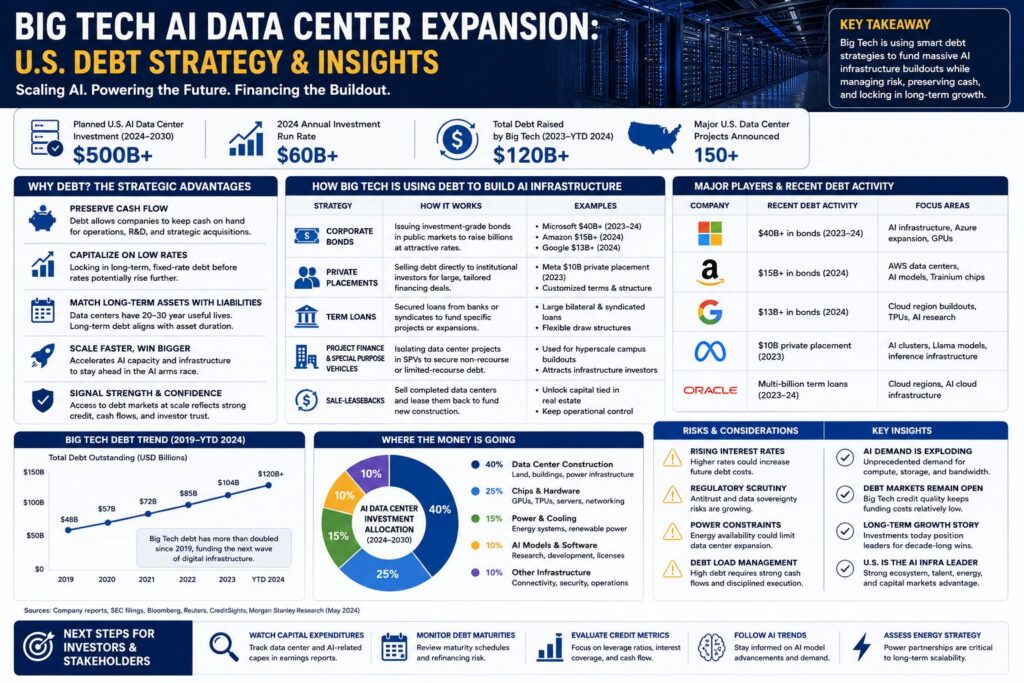
- Big Tech has added $121 billion in new debt in 2025 alone — more than four times the average annual issuance over the previous five years — with over $90 billion of that raised in just three months.
- The total cost to build out AI data center infrastructure is estimated at $3 trillion, with hyperscalers projected to spend $725 billion in 2025 and $602 billion in 2026 — a 36% year-over-year jump.
- Approximately 75% of that capital spending flows directly into AI infrastructure, making data centers the single largest investment category in modern tech history.
- UBS and JPMorgan estimate AI’s infrastructure push could drive up to $1.5 trillion in additional borrowing by tech companies in the coming years — a figure that is already reshaping bond and credit markets.
- The debt strategy isn’t reckless — it’s calculated. Keep reading to understand exactly why borrowing makes more financial sense for these companies than spending their own cash reserves.
The biggest infrastructure bet in modern technology history is happening right now, and it’s being funded with borrowed money at a scale that’s rewriting the rules of corporate debt markets.
Big Tech’s race to build AI data centers has moved well beyond a capital expenditure line item — it’s become a defining financial story of the decade. Understanding what’s being built, who’s borrowing, and what it all means for the future of AI infrastructure is essential context for anyone watching the technology sector right now. For readers looking to go deeper on data center trends, technology growth reporting from outlets like Data Center Dynamics provides ongoing coverage of how this build-out is unfolding at the infrastructure level.
$350 Billion in Debt and Counting
Alphabet, Amazon, Meta, Microsoft, and Oracle have collectively taken on roughly $350 billion in debt to fund their AI data center ambitions. That number has more than doubled in the last five years, driven almost entirely by the explosive demand for AI compute capacity. This isn’t a slow-burn infrastructure story — it’s an acceleration unlike anything these companies have done before.
Hyperscalers added $121 billion in new debt in 2025 alone, which is more than four times their average annual issuance over the previous five years, according to Bank of America. What’s even more striking is that over $90 billion of that came in just a three-month window. The pace of borrowing has left even seasoned credit market analysts recalibrating their models.
The Five Companies Driving the Spending Surge
The spending is concentrated among a small group of companies with the scale, credit ratings, and revenue streams to support this kind of borrowing. Alphabet raised $25 billion in a single bond offering. Meta tapped the bond market for $30 billion. Oracle executed an $18 billion bond issuance. Amazon has issued tens of billions across multiple tranches. Microsoft, already one of the most active corporate bond issuers globally, has continued adding to its debt stack in parallel with its OpenAI partnership expansion.
These aren’t companies in financial distress reaching for leverage — they’re profitable giants choosing debt as a deliberate financing tool. Each of them generates enough free cash flow to service these obligations comfortably, which is precisely what makes the bond market receptive to absorbing this volume.
Why Borrowing Beats Burning Cash Reserves
When interest rates are manageable and a company has investment-grade credit ratings, issuing bonds is often smarter than drawing down cash. Debt preserves liquidity, provides tax advantages on interest payments, and allows companies to keep their cash working in other high-return areas. For hyperscalers operating at this scale, the cost of borrowing is frequently lower than the opportunity cost of deploying their own capital.
There’s also a strategic signaling dimension. Large bond issuances communicate to investors, competitors, and regulators that these companies are fully committed to AI infrastructure — not hedging. It’s a public declaration of intent, backed by legally binding financial obligation.
The $3 Trillion Price Tag Behind AI Infrastructure
More than $3 trillion. That’s the number analysts have attached to the full cost of building the data center infrastructure needed to support the AI era. It’s a figure that’s difficult to contextualize until you break down where the money actually goes — and why every component of a modern AI data center is extraordinarily expensive.
What Actually Costs That Much
Building a hyperscale AI data center involves far more than steel, concrete, and servers. The cost structure includes land acquisition in power-dense corridors, high-voltage electrical infrastructure, cooling systems capable of handling massive thermal loads, fiber connectivity, and the physical buildout itself. A single large-scale facility can run $10 billion or more before a single GPU is installed.
Why Nvidia Chips Are Central to the Bill
The Nvidia H100 and H200 GPU clusters that power AI training and inference workloads are among the most expensive compute components ever produced at scale. A single H100 server rack can cost hundreds of thousands of dollars, and hyperscalers are deploying these in clusters of tens of thousands of units. When 75% of projected capital spending flows directly into AI infrastructure — as analysts estimate — a significant portion of that is Nvidia silicon and the specialized infrastructure required to run it.
How $725 Billion in 2025 Spending Fits Into the Bigger Picture
Analysts project hyperscalers will spend $725 billion on capital expenditures in 2025, rising to $602 billion in 2026 — though that 2026 figure represents a 36% year-over-year increase from prior baselines, not a decline. The numbers reflect a multi-year build cycle that won’t peak for several years. Each new generation of AI models requires more compute than the last, which means each successive data center generation needs to be larger, faster, and more power-dense than what came before.
- Land and real estate: Proximity to power sources and fiber corridors drives site selection costs higher in competitive markets
- Power infrastructure: Grid connection agreements, on-site substations, and backup generation add hundreds of millions per campus
- Cooling systems: Liquid cooling and direct-to-chip thermal management for GPU-dense racks represent a growing share of buildout costs
- Compute hardware: Nvidia H100/H200 GPU clusters, custom ASICs, and networking hardware represent the single largest line item
- Fiber and connectivity: Long-haul and last-mile fiber buildout to interconnect campuses across regions
- Construction and labor: Specialized data center construction has outpaced general commercial construction costs significantly
How Big Tech Is Financing the Build-Out
The financing mechanics behind the AI data center build-out are as sophisticated as the technology itself. Rather than relying on a single funding approach, hyperscalers are deploying a mix of corporate bonds, revolving credit facilities, and structured debt instruments across multiple currencies and maturities. This diversification isn’t accidental — it’s designed to spread refinancing risk and tap into the deepest pools of global capital available.
Corporate Bonds Issued Across Multiple Currencies
Issuing bonds in euros, British pounds, and Japanese yen alongside U.S. dollar denominations gives hyperscalers access to institutional investors across different regulatory environments and yield expectations. European investors, in particular, have shown strong appetite for investment-grade U.S. tech debt, which often offers a yield premium over comparable European corporate bonds. This currency diversification also provides a natural hedge for companies with significant international revenue streams funding infrastructure costs denominated in non-dollar currencies.
Meta’s Off-Balance-Sheet Borrowing Strategy
Meta has been particularly aggressive in structuring debt in ways that minimize balance sheet impact while maximizing capital deployment flexibility. The company tapped bond markets for $30 billion, using a combination of senior unsecured notes across multiple tranches with staggered maturities ranging from 5 to 40 years. The ultra-long 40-year tranche is notable — it signals that Meta is treating this infrastructure as a generational investment, not a short-cycle technology bet. For those interested in understanding more about such strategic financial decisions, exploring AI governance frameworks can provide valuable insights.
This maturity ladder approach is deliberate. By spreading repayment obligations across decades, Meta avoids creating concentrated refinancing pressure at any single point in the credit cycle. It also locks in current interest rates for infrastructure that management believes will generate returns well into the 2050s and beyond.
Amazon’s $25 Billion Bond Issuance and Its Cold Reception
Amazon’s bond issuance drew significant attention, though not entirely for the reasons the company might have preferred. While the offering was ultimately absorbed by the market, it came at a moment when investors were beginning to ask harder questions about the pace of AI infrastructure spending and the timeline for returns. The sheer size of the issuance — $25 billion in a single raise — put pressure on spreads and drew comparisons to sovereign debt offerings in scale.
Credit analysts noted that Amazon’s AWS division remains the primary justification for the debt load, with its cloud revenue providing the clearest direct link between data center investment and recurring income. However, the portion of spending tied to speculative AI workloads — where demand curves are still being established — introduced a layer of uncertainty that some investors priced into their yield requirements.
The key tension for Amazon, and for hyperscalers generally, is the lag between capital deployment and revenue recognition. Data centers take 18 to 36 months to move from groundbreaking to revenue-generating capacity. That gap means billions in interest expense accrues before a single dollar of AI-driven revenue flows through the income statement.
Hyperscaler Debt Issuance Snapshot (2025)
Company Debt Raised (2025) Notable Issuance Primary Use Alphabet $25 billion Multi-tranche bond offering AI data center buildout Meta $30 billion 5- to 40-year senior unsecured notes AI infrastructure & compute Oracle $18 billion Single bond issuance Cloud & AI expansion Amazon $25 billion+ Large-scale multi-tranche raise AWS & AI capacity Sector Total (2025) $121 billion 4x average annual issuance AI data center infrastructure
Wall Street’s Bet on AI Returns
Wall Street isn’t just watching the AI data center build-out — it’s actively financing it, and in doing so, placing one of the largest collective bets on technological returns in financial history. The bond market’s willingness to absorb $121 billion in hyperscaler debt in a single year reflects deep institutional conviction that AI infrastructure will generate the cash flows needed to service these obligations. But conviction and certainty are different things.
The investment banks structuring and underwriting these deals stand to earn substantial fees regardless of whether the underlying AI investments pay off. That misalignment of incentives is worth noting, because the most bullish forecasts about AI’s economic returns tend to originate from the same institutions profiting from facilitating the debt issuance. Credit analysts within those same institutions are, in some cases, publishing more cautious assessments in parallel.
What’s clear is that the debt market has become as central to the AI story as the technology itself. Without access to low-cost, large-scale borrowing, the pace of data center construction would slow dramatically. The bond market is, in a very real sense, the infrastructure beneath the infrastructure.
Morgan Stanley and JPMorgan Forecast $1.5 Trillion in Additional Borrowing
UBS and JPMorgan analysts estimate that AI’s infrastructure push could drive up to $1.5 trillion in additional borrowing by tech companies in the coming years. That projection assumes continued demand growth for AI services, sustained investor appetite for investment-grade tech debt, and no significant credit market disruption. All three assumptions are reasonable today — but none are guaranteed across a multi-year horizon at this scale.
UBS Projects $900 Billion in New Issuance for 2026 Alone
UBS has put forward projections suggesting that new debt issuance tied to AI infrastructure could reach $900 billion in 2026 alone. If realized, that would represent a corporate bond market event with few historical precedents outside of wartime industrial mobilization or post-financial-crisis bank recapitalization. The absorption of that volume by global credit markets would require sustained institutional demand and stable interest rate conditions — factors that are currently favorable but inherently unpredictable.
What Credit Analysts Are Actually Worried About
- Refinancing concentration risk: Multiple hyperscalers issuing at similar maturities creates clustered refinancing windows that could strain markets simultaneously
- Revenue timing mismatch: 18-to-36-month construction lag means interest expense precedes AI revenue generation by years
- Demand uncertainty: Enterprise AI adoption curves are still being established — projected compute demand may not materialize at the pace that justifies current build rates
- Rate sensitivity: While current rates are manageable, a sustained high-rate environment increases refinancing costs on shorter-duration tranches
- Competitive overcapacity: If multiple hyperscalers overbuild simultaneously, pricing pressure on cloud AI services could compress the margins needed to service debt
- Geopolitical supply chain exposure: Nvidia GPU supply chains and rare earth dependencies introduce cost and availability risks that aren’t fully priced into current debt models
These concerns haven’t translated into meaningful spread widening yet, which tells you something about current market sentiment. Investment-grade tech debt continues to price tightly relative to comparable corporate issuers, suggesting that bond investors broadly accept the AI growth thesis — at least for now.
The more nuanced worry isn’t that these companies will default — they won’t. The real concern is whether the returns from AI data center investments will justify the opportunity cost of this capital, especially if AI revenue growth disappoints relative to the scale of infrastructure being deployed.
Credit markets can absorb large issuances from creditworthy borrowers almost indefinitely, but they reprice quickly when the underlying earnings story changes. The hyperscalers have significant buffer — but that buffer isn’t infinite, and the market knows it.
The ROI Question No One Can Answer Yet
The most honest thing that can be said about AI data center return on investment is that nobody — not the companies building them, not the banks financing them, not the analysts covering them — has a reliable model for what these assets will generate over their 20-to-40-year useful lives. That’s not a criticism. It’s simply the reality of investing in transformational infrastructure before the applications that will run on it are fully defined.
- Cloud AI services: Charging enterprise customers for AI inference and training compute via AWS, Azure, and Google Cloud — the most direct and measurable revenue stream
- Internal productivity gains: Using AI to reduce operational costs across advertising, logistics, search, and software development — harder to quantify but potentially enormous
- New product categories: AI agents, autonomous systems, and yet-to-be-defined applications that don’t exist in current revenue models
- Data network effects: Each additional workload run on proprietary AI infrastructure generates training data that improves model quality — a compounding asset that doesn’t appear on balance sheets
The AWS precedent is instructive here. When Amazon began building out its cloud infrastructure in the mid-2000s, the investment looked wildly speculative relative to the company’s retail core. Today, AWS generates margins that fund Amazon’s entire business model. Hyperscalers are explicitly betting that AI infrastructure will follow a similar trajectory — from speculative buildout to indispensable utility.
But the AWS comparison has limits. Cloud infrastructure scaled gradually, with enterprise adoption tracking relatively predictable IT budget cycles. AI infrastructure is being built at a pace that assumes demand will materialize faster and at greater scale than any prior technology transition. The gap between those assumptions and actual enterprise AI adoption is where the financial risk lives.
What makes the ROI question particularly difficult is that the competitive dynamics are self-reinforcing. Even if a hyperscaler privately believes the buildout is ahead of demand, it cannot afford to stop building — because falling behind in AI compute capacity means ceding ground to competitors in a winner-takes-most market. The spending is, in part, defensive.
Signs the Debt Market Is Hitting Its Limits
For most of 2024 and into 2025, the debt markets absorbed AI infrastructure issuance with remarkable ease. Spreads stayed tight, books were oversubscribed, and pricing came in at or better than guidance on most major deals. That environment reflected a genuine belief among institutional investors that hyperscaler credit was among the safest corporate debt available — effectively quasi-sovereign in its risk profile.
But there are early signals that the market’s capacity for this volume isn’t unlimited. Amazon’s large-scale raise showed some signs of spread pressure at the margin. Certain longer-duration tranches from other issuers have required modest concessions to clear the market. And derivatives markets — specifically credit default swap spreads on hyperscaler names — have begun to reflect a subtle but measurable uptick in perceived risk, even as headline credit ratings remain stable.
Investor Appetite Is Strong But Not Unlimited
The bond market’s capacity to absorb AI infrastructure debt is genuinely impressive — but it operates within boundaries that are now being tested. Institutional investors including pension funds, insurance companies, and sovereign wealth funds have been the primary buyers of hyperscaler debt, drawn by investment-grade ratings and yields that modestly exceed comparable Treasury benchmarks. That demand has been consistent, but the sheer volume being issued is beginning to create what credit professionals call “indigestion” — a point where new supply temporarily exceeds the market’s ability to absorb it without requiring pricing concessions.
The most telling indicator isn’t spread widening on individual deals — it’s the cumulative weight of supply hitting the market across a compressed timeframe. When Alphabet, Meta, Amazon, and Oracle all issue within the same quarter, the combined volume competes for the same institutional capital. Book coverage ratios, while still healthy, have shown a gradual decline from the dramatically oversubscribed levels seen in 2023 and early 2024. The market is still open, but it’s working harder to clear.
What the Derivatives Market Signals About Risk Sentiment
Credit default swap spreads on the major hyperscalers remain tight by historical standards, but they’ve moved. Even a 5-to-10 basis point widening on CDS for names like Amazon or Alphabet is significant when you consider the volume of debt outstanding — it translates to meaningful shifts in implied default probability across billions in notional exposure. Derivatives traders are not predicting distress. What they’re doing is pricing in a small but growing probability that the AI revenue thesis takes longer to materialize than the debt maturities require.
Options markets on hyperscaler equities tell a similar story. Implied volatility skew on names with the heaviest AI capex commitments has shifted, with put protection becoming modestly more expensive relative to calls. This isn’t a bearish signal in isolation — but in the context of record debt issuance, it suggests that sophisticated market participants are quietly hedging against scenarios where the infrastructure investment cycle outpaces the revenue cycle by a wider margin than currently expected.
This Is the Biggest Infrastructure Bet in Modern Tech History
Put everything together and what you’re looking at is without precedent in the history of corporate technology investment. The $3 trillion build-out of AI data centers, financed through $350 billion in accumulated debt with up to $1.5 trillion more potentially on the way, represents a level of capital commitment that dwarfs the dot-com buildout, the broadband infrastructure wave of the early 2000s, and the first generation of hyperscale cloud construction combined. The companies making these bets are the most profitable businesses in human history — and they’re still choosing to borrow to fund them, which tells you everything about the scale they’re operating at.
Whether the AI applications that justify this infrastructure materialize at the pace and scale required to service $1.5 trillion in debt is the defining financial question of the next decade. The hyperscalers have the balance sheets to absorb a significant miss. The bond markets have the depth to continue financing the build. But the underlying bet — that AI will generate sufficient economic value to justify the largest voluntary corporate infrastructure investment ever undertaken — is still being proven, one quarter at a time.
Frequently Asked Questions
The questions coming from investors, analysts, and technology observers about big tech AI data center spending tend to cluster around the same core issues: the financial logic, the scale, and the risk. Here are the answers to the ones that matter most.
Why Are Big Tech Companies Taking on Debt Instead of Using Their Own Cash?
The short answer is that borrowing is simply more efficient for companies at this scale and credit quality. When a company like Alphabet or Meta can issue 10-year bonds at interest rates that are lower than their internal hurdle rate for capital deployment, using borrowed money to fund infrastructure while keeping cash reserves working in higher-return activities is straightforward financial optimization. For a deeper understanding of how companies like these leverage business intelligence services, you can explore the comparison between IBM Watson and Google Cloud AI.
There’s also a tax dimension that makes debt structurally attractive. Interest payments on corporate debt are generally tax-deductible, which reduces the effective cost of borrowing below the stated coupon rate. For companies generating tens of billions in annual taxable income, this deduction is worth billions in annual tax savings.
Beyond the pure math, debt financing provides strategic flexibility. A company that deploys its entire cash reserve into data centers loses the ability to respond opportunistically to acquisitions, market dislocations, or unexpected competitive threats. Keeping cash on the balance sheet while using debt for infrastructure preserves that optionality.
The deeper strategic logic is competitive signaling. In a race where the winner likely takes a dominant share of the AI compute market, demonstrating financial commitment through large public bond issuances signals to competitors, customers, and regulators that these companies are in this for the long term — not hedging their bets. For more insights on how companies are navigating AI governance, explore this AI governance framework.
- Lower effective cost: Investment-grade borrowing rates are often below internal opportunity cost of capital for these companies
- Tax efficiency: Interest deductibility reduces the real cost of debt financing significantly at hyperscaler income levels
- Liquidity preservation: Keeps cash reserves available for acquisitions, buybacks, and unexpected strategic needs
- Competitive signaling: Public debt issuances demonstrate long-term commitment to AI infrastructure at scale
- Maturity matching: Long-duration bonds can be matched to the 20-to-40-year useful life of data center assets
Which Companies Are Spending the Most on AI Data Centers?
The five companies driving the majority of AI data center spending are Alphabet, Amazon, Meta, Microsoft, and Oracle. Among these, Meta has been particularly aggressive with its $30 billion bond issuance structured across maturities ranging from 5 to 40 years. Alphabet raised $25 billion, Amazon raised over $25 billion, and Oracle executed an $18 billion bond offering — all within the same general period of accelerated infrastructure investment.
Microsoft deserves specific mention for its structural position: its partnership with OpenAI means it’s building AI data center capacity not just for its own Azure cloud customers but to support the compute demands of the most widely used AI models in the world. That dual obligation — serving external customers while supporting a foundational AI partner — puts Microsoft’s infrastructure requirements in a category of their own.
What Is the Total Cost to Build Out AI Data Center Infrastructure in the U.S.?
Analysts have put the total cost of the AI data center build-out at more than $3 trillion globally, with the United States representing the largest single geography for new capacity. The U.S. concentration reflects several factors: proximity to the largest enterprise AI customer base, established power grid infrastructure in key data center corridors, and the geographic preference of the major hyperscalers whose headquarters and primary cloud regions are domestic.
Projected capital expenditures for hyperscalers reached $725 billion in 2025, with that figure expected to climb to $602 billion in 2026 — representing a 36% year-over-year increase from prior baselines. Approximately 75% of that spending flows directly into AI infrastructure components, meaning the actual dollars going into GPU clusters, cooling systems, power infrastructure, and specialized data center construction represent the overwhelming majority of total capex.
How Much More Debt Could Tech Companies Take on for AI?
UBS and JPMorgan analysts estimate that the AI infrastructure push could drive up to $1.5 trillion in additional borrowing by tech companies in the coming years. UBS projections suggest new debt issuance tied to AI infrastructure could reach $900 billion in 2026 alone. Those numbers are based on current build rate trajectories, projected GPU procurement cycles, and the capital requirements of the next generation of data center campuses being planned today.
The practical ceiling isn’t a debt-to-equity ratio or a coverage threshold — the hyperscalers are so far inside conventional credit safety margins that the traditional limits don’t bind. The real ceiling is market absorption capacity: the question of whether global institutional investors can continue to deploy capital into hyperscaler bonds at the rate required to fund the build-out without requiring materially higher yields that would change the economics of the financing strategy.
Will Big Tech Actually Get a Return on These Massive AI Investments?
The honest answer is that no one can say with certainty — and the companies themselves have acknowledged this in their investor communications. What the hyperscalers can point to is the AWS precedent: Amazon’s early cloud infrastructure investment looked speculative for years before it became the dominant, high-margin engine of the entire company. The argument is that AI infrastructure will follow a similar path from capital-intensive buildout to indispensable utility.
The revenue streams that are expected to service this debt are already partially visible. Cloud AI services — charging enterprise customers for training and inference compute via AWS, Azure, and Google Cloud — are generating real and growing revenue today. Internal productivity gains from deploying AI across advertising targeting, logistics optimization, and software development are reducing costs in ways that show up in margin expansion even before new AI products reach customers.
What remains genuinely uncertain is the pace of enterprise AI adoption and whether the demand for AI compute will scale as fast as the infrastructure being built to serve it. The gap between a $3 trillion infrastructure commitment and current AI revenue levels is enormous — and bridging that gap over the useful life of these assets is the central financial challenge of the AI era. The hyperscalers are betting they’ll get there. The bond market is, for now, betting with them.
For ongoing analysis of how data center infrastructure is evolving to meet the demands of the AI era, Data Center Dynamics continues to track the build-out across technology, power, and financial dimensions.