
Summary of the Article
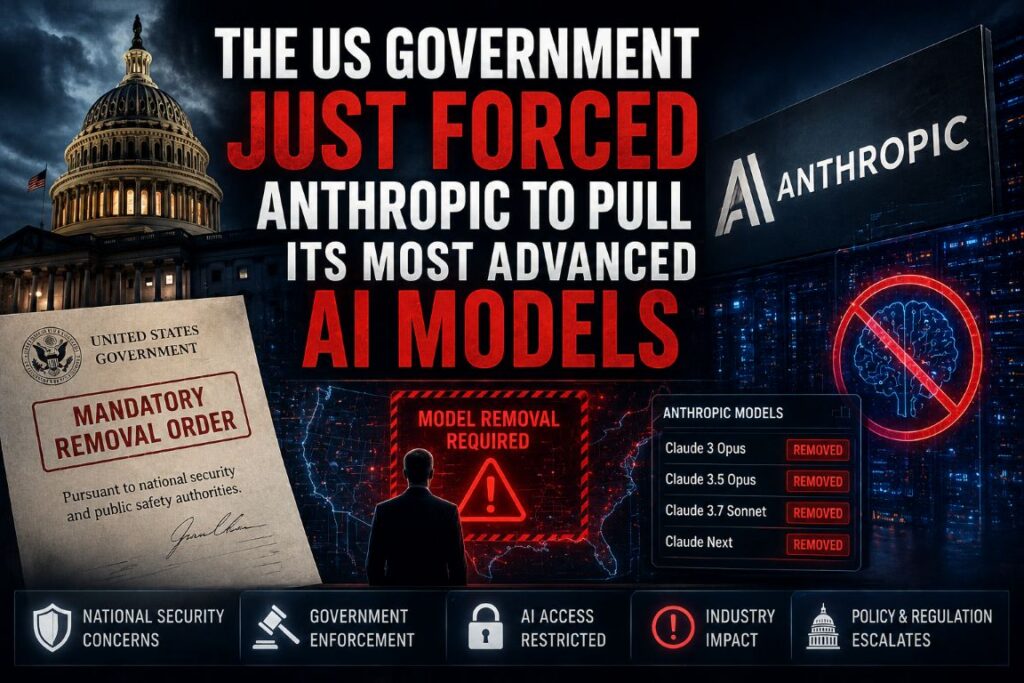
- All US federal agencies were ordered by the Trump administration to immediately stop using Anthropic’s AI technology, with the Pentagon given a six-month phase-out window.
- Anthropic refused to give the military unrestricted access to its Claude AI models, holding firm on two specific safety limits that became the breaking point.
- OpenAI struck a deal with the Pentagon within hours of Anthropic’s ouster — but kept the same safety restrictions Anthropic was punished for maintaining.
- The government used a “supply chain risk” designation against Anthropic, a tool normally reserved for companies tied to US adversaries — never before used against an American firm.
- This clash signals a defining moment for every AI company with government contracts: what happens when your ethical limits collide with military demands?
The US federal government just forced out one of the most powerful AI companies in the world — and the ripple effects are still spreading.
Anthropic, the AI safety company from San Francisco that created the Claude family of models, found itself in an unexpected and very public disagreement with the Trump administration after it declined to provide the Pentagon with unlimited access to its AI technology. The dispute ended with a presidential order that led to Anthropic being removed from almost all federal operations. People who are interested in technology and policy at organizations like the Future of Life Institute have been monitoring the conflict between AI safety principles and the demands of national security for years. However, few of them expected it to become this public, this quickly.
Anthropic Is Now Banned From US Government Operations
President Trump announced on Truth Social that most federal agencies must stop using Anthropic’s AI technology immediately. The Pentagon was given six months to phase out the technology that is already in use in military platforms. This is a small concession considering how much Anthropic’s models are used in active operations.
The order wasn’t unexpected. It came after days of mounting pressure from senior Trump officials, including Defense Secretary Pete Hegseth, who accused Anthropic of “endangering critical military operations and potentially exposing our soldiers to danger.” The State Department joined the fray, with officials criticizing the company’s CEO, Dario Amodei, on social media for not meeting a Friday deadline set by the government.
Jack Shanahan, a retired Air Force General who used to be in charge of the Pentagon’s AI projects, has openly criticized the government’s strategy. He publicly stated that the government’s decision to target Anthropic may make for interesting news, but it’s a lose-lose situation. This type of straightforward military disagreement from within the system shows that this was not a straightforward national security decision; it was a power struggle.
The Two Safeguards Anthropic Wouldn’t Remove for the Pentagon
At the heart of this disagreement are two specific safeguards Anthropic would not remove from its Claude models for military use.
The Double Red Lines: Mass Surveillance and Autonomous Weapons
Anthropic has openly declared its readiness to back the Department of Defense and warfighters, but only if two conditions are met. The firm would not permit Claude to be utilized for mass civilian surveillance initiatives or for completely autonomous lethal weapons systems that operate without significant human supervision. These were not abstract philosophical stances; they were firm boundaries ingrained in the way Claude’s usage policies were formulated and implemented.
The Reason Anthropic Refuses to Comply
In a public announcement, Anthropic stated that it could not, in good faith, remove those restrictions. They presented them not as hindrances to military capabilities, but as basic ethical obligations. The company also highlighted its history of cooperation on national security matters. It voluntarily forfeited several hundred million dollars in revenue by denying Claude access to companies associated with the Chinese Communist Party. This decision cost Anthropic actual money to safeguard American interests.
Conflicting Orders from the Pentagon
At this point, the government’s stance became unclear. Defense Secretary Hegseth demanded “full, unrestricted access to Anthropic’s models for every LAWFUL purpose.” However, Anthropic’s statement clarified a key point: the company had never interfered with specific military operations or attempted to question the Pentagon’s decisions. They had merely established usage policies, just like any other AI vendor. Essentially, the administration was asking a private American company to completely relinquish control of its safety architecture to the military, without any conditions.
Understanding the Execution of Trump’s Order
There were two separate timelines for the executive action, each depending on the government division involved.
Immediate Stop for Most Agencies
The majority of federal civilian agencies were ordered to stop immediately. There would be no new deployments, no continued use of existing Claude integrations, full stop. Any agency already using Anthropic’s technology was expected to start moving away from it immediately.
The Pentagon’s Six-Month Phase-Out Window
The military was granted additional time, but this was only because Anthropic’s models were already heavily integrated into active defense platforms. A hard cutoff would have resulted in operational disruptions that the Pentagon was not prepared for — which ironically highlighted just how dependent the military had become on the very technology it was now expelling. For more context on this, you can read about Elon Musk’s controversial reactions to Anthropic.
Warnings of Civil and Criminal Penalties
The government went beyond a simple ban on use. Officials also mentioned the potential for civil and criminal penalties linked to Anthropic’s non-compliance, dramatically increasing the stakes from a typical contract disagreement to a much more assertive and legally unprecedented area for a domestic AI firm.
Understanding the “Supply Chain Risk” Label
The government’s most impactful — and contentious — move was officially labeling Anthropic a supply chain risk. This designation is a big deal in the world of federal procurement law and can have serious repercussions for any company that gets slapped with it.
Anthropic was labelled by Defense Secretary Hegseth, activating a formal process that permits the government to limit or prohibit the purchase of products from a designated supplier. It’s a potent instrument on paper. However, it was created to address a very specific danger.
The Purpose of the Supply Chain Risk Designation: The supply chain risk designation, a tool created by federal law, was designed to target companies owned or controlled by adversaries of the US. This includes Chinese telecom hardware manufacturers and Russian software vendors that could potentially install backdoors, surveillance capabilities, or vulnerabilities into products used by the US government. The designation is in place to protect national security infrastructure from foreign interference that is potentially hostile.
Labeling Anthropic, a San Francisco-based American company that was established by previous OpenAI researchers, is funded by Google and Amazon, and has publicly pledged to AI safety, is a new application of this tool. Legal professionals pointed out that this method was not designed with domestic companies in mind, and that using it in this manner could result in significant legal issues.
What This Designation Usually Means
The supply chain risk designation is a serious federal procurement tool, not a simple claim. When used, it indicates that a supplier poses a real risk to the integrity of government systems — usually because the company is connected to a foreign adversary that could take advantage of access to sensitive infrastructure. The designation has traditionally been used against companies like Huawei and ZTE, Chinese telecom behemoths flagged for their connections to the Chinese government and potential to facilitate surveillance through their hardware and software.
Once a company has been identified, it can be prevented from selling to federal agencies, have existing contracts terminated, and face restrictions that effectively lock them out of the entire government market. This is a wide-ranging action with long-lasting effects — and it was designed specifically for threats coming from outside the United States.
The Unprecedented Application to a U.S. Company
Anthropic is a domestic company, not a foreign one. It was established in 2021 by Dario Amodei, Daniela Amodei, and a number of other former OpenAI researchers, all of whom are American citizens based in San Francisco. The company has received significant investment from Google and Amazon, is publicly committed to AI safety research, and has already taken voluntary measures to safeguard American national security interests, including severing revenue streams from firms linked to the Chinese Communist Party. The use of a tool intended for foreign adversaries on a domestic company that has actively supported national security objectives is a completely different proposition, both legally and strategically.
OpenAI Didn’t Waste Any Time
As Anthropic was being formally evicted, its longtime competitor didn’t miss a beat. OpenAI’s CEO, Sam Altman, announced a new partnership with the Pentagon to provide AI technology to classified military networks just hours after the government took action against Anthropic. The timing was hard to ignore.
Altman’s Pentagon Deal on the Same Night
On the same day that Anthropic was penalized for missing the government’s deadline, Altman announced a deal between OpenAI and the Pentagon. This agreement would allow the US military to use OpenAI’s models in classified environments, potentially filling the exact operational gap left by Anthropic’s removal from defense platforms.
Altman also made a pointed public statement expressing hope that the Pentagon would “offer these same terms to all AI companies” as a path to de-escalation. It was a diplomatic move that simultaneously positioned OpenAI as the cooperative alternative while subtly criticizing the government’s aggressive posture toward Anthropic.
The Catch: OpenAI Retained the Same Safety Boundaries that Anthropic Was Penalized For
Here’s the fact that cuts through all the chatter: Altman confirmed that OpenAI’s new Pentagon deal includes the same safety boundaries that Anthropic was penalized for holding. The limits around mass civilian surveillance and autonomous lethal weapons systems that the government labelled a national security risk when Anthropic held them? They’re still in OpenAI’s contract.
There’s a clear paradox at the heart of this whole argument. If these safety restrictions were really putting soldiers at risk as Hegseth argued, why would the Pentagon instantly strike a deal with a rival that maintains those same restrictions? This indicates that this disagreement was never solely about operational capacity—it was about who had the power to dictate the conditions.
The Implications for the Federal AI Market
There are now changes in the federal AI market, at least for the time being. OpenAI has entered the classified military sector with a substantial new contract, while Anthropic is barred from most federal activities. Other AI vendors, including Google DeepMind, Meta, and Microsoft’s Azure AI division, are closely observing to comprehend what adherence to government AI requirements will entail in the future.
The underlying message here is that the government can swiftly use administrative measures to replace one vendor with another, citing safety policy as the reason. This alters the dynamics for every AI firm currently holding or seeking federal contracts.
What Anthropic Stands to Gain — and What It Doesn’t
While losing federal government contracts is a blow, Anthropic’s financial standing is stronger than it may seem. The company has evolved from a specialized AI safety research lab to one of the most lucrative AI startups worldwide, with clients in the healthcare, finance, legal, and technology sectors that far outweigh its government revenue. Federal contracts, although esteemed, were never the backbone of Anthropic’s business model.
The Monetary Consequences of Losing Government Contracts
Anthropic is in a position to endure the loss of government income, at least for the time being. The company is supported by billions of dollars in investment from Google and Amazon and has established a significant business enterprise around Claude. The federal government was a growing, but not the major part of that revenue mix. However, the longer this prohibition stays in effect, the more it will compound, as rival relationships become more entrenched in agencies that might have otherwise expanded their use of Claude.
Anthropic took a voluntary decision to forfeit hundreds of millions of dollars in revenue by severing ties with CCP-affiliated companies, a decision it weathered. While the loss of government contracts is a bigger blow, Anthropic is financially robust and not in dire straits as it faces this challenge.
The Greater Threat: Reputation and Industry Collaborations
The stakes for reputation are more intricate. On the one hand, maintaining strong safety limits in the face of government pressure enhances Anthropic’s credibility with corporate clients and researchers who selected Claude specifically for its principled stance on AI development. On the other hand, being tagged as a supply chain risk — even unjustly — produces tension with prospective partners who must steer clear of regulatory issues in their own government-related work.
Big tech firms that have incorporated Claude into their platforms, even those with their own federal contracts, are now under scrutiny to determine if this integration presents compliance risks. This indirect impact could be more harmful than the direct loss of contracts.
Anthropic Is Taking Legal Action
Anthropic is not taking the government’s actions lying down. The company has indicated that it will take legal action against both the supply chain risk designation and the broader executive order, arguing that using federal procurement law against a domestic American company for maintaining standard AI safety policies is legally indefensible. The results of these legal actions could determine not only Anthropic’s future in government markets, but also the limits of executive power over private AI companies in general.
A Broader Issue at Hand
When you remove the specific actors and the financial figures from the equation, you’re left with a fundamental question that the entire AI industry is now grappling with: who gets to set the ethical boundaries of artificial intelligence when it’s used for military purposes – the companies that create it, or the governments that deploy it?
Anthropic believes that private corporations should have the ability to establish safety restrictions on the use of their technology, even when it is being used by sovereign governments. The Trump administration, on the other hand, believes that once a company sells to the military, the military has the right to dictate the terms of use without any restrictions. These two perspectives cannot be reconciled through negotiations. Instead, they require a legal and political solution, something the US currently lacks a clear framework for.
The Central Struggle: AI Safety versus Military Requirements
The Anthropic conflict is not a single contract dispute — it’s the first major public clash between two forces that have been on a crash course since AI became operationally beneficial to the military. AI safety researchers have spent years arguing that certain uses of AI — especially in lethal autonomous systems and mass surveillance — need strict boundaries, regardless of who is asking. Military planners have spent the same years arguing that operational effectiveness necessitates unrestricted access to all available tools. Both positions make sense in their own right. However, they cannot coexist without a framework that neither side has yet agreed upon.
What Occurs When Private AI Firms Establish Ethical Boundaries
When a private firm creates a product and sells it commercially, it has the right to establish terms of use. This is a common practice in all technology sectors, from cloud computing to semiconductors to cybersecurity software. Anthropic’s maintenance of usage policies on Claude was not out of the ordinary. What made this situation volatile was the target: the US military, under an administration that sees any limitation on executive power as a threat to national security.
The government’s stance is that when you accept federal funds and incorporate your technology into defense infrastructure, you lose the right to restrict how that technology is used. Anthropic, on the other hand, argues that preserving those restrictions is exactly what makes the technology reliable enough to use on a large scale. Both of these arguments will now be tested in court, in Congress, and in every AI procurement negotiation currently taking place in Washington.
What This Means for All AI Companies That Work With the Government
Every AI company that works with the federal government is likely asking themselves the same question that Anthropic just had to face: would their own usage policies, safety guidelines, and ethical frameworks stand up to the kind of scrutiny that ended Anthropic’s relationship with the government? The truth is, most of them probably don’t know.
The Anthropic case has shown us that the government is ready to use harsh administrative measures, including those typically used for foreign adversaries, to ensure domestic AI companies comply. This greatly changes the risk profile of federal AI contracts. A contract that seemed like a revenue opportunity half a year ago now has the implicit condition that the government can overrule your safety architecture if it deems your limits inconvenient.
- AI companies with existing federal contracts are now being urged to conduct a thorough audit to ensure their usage policies do not become the next point of contention.
- Companies seeking new federal contracts must now decide how much control they are willing to give to government clients.
- Enterprise clients in industries adjacent to the government are now reconsidering whether the integration of AI tools with federal safety restrictions could create a compliance risk for them.
- International AI vendors now have a better understanding of how the US government views the sovereignty of private AI governance, thanks to this dispute.
- AI safety researchers and ethicists are documenting this case as a significant data point in the ongoing debate about who governs military AI.
This precedent is not just about Anthropic. It’s about whether the AI industry can maintain meaningful ethical self-governance, or whether government clients, particularly the military, can override these frameworks whenever it suits their operational goals, using administrative and legal pressure.
Everyone in the AI Sector Is Keeping a Close Eye
Whether it’s in the boardrooms of Silicon Valley or in the labs where AI ethics are studied, all those who have a stake in the future of artificial intelligence are keeping a close eye on this controversy. The Anthropic case has turned a previously abstract debate into something tangible and significant. OpenAI, Google DeepMind, Meta AI, Mistral, and dozens of smaller AI vendors are all currently deciding how to align themselves with the line that Anthropic has drawn — and the price that Anthropic has paid for drawing it. The results of Anthropic’s legal challenges, and whether the government’s supply chain risk designation can withstand a legal review, will influence AI policy in the United States for many years to come.
Common Questions
Here are the most pressing questions about the US government’s decision to force Anthropic’s AI models out of federal operations — answered directly.
What led the US government to push Anthropic to pull its AI models?
Anthropic was pushed out of federal operations by the US government after the firm declined to eliminate two particular safety limits on its Claude AI models when used for military purposes. Defense Secretary Pete Hegseth and other senior Trump officials demanded complete, unrestricted access to Claude for all legal military purposes by a certain Friday deadline. Anthropic’s CEO Dario Amodei did not comply with that deadline while the two safety measures were in effect.
The Trump administration reacted by instructing the majority of federal agencies to cease using Anthropic’s technology immediately, branding the firm as a supply chain risk, and suggesting the possibility of civil and criminal repercussions. The Pentagon was given a six-month phase-out period because Anthropic’s models were already deeply embedded in active military platforms — a detail that reveals how crucial Anthropic’s role in defense AI had become prior to the fallout.
This was not merely a disagreement over a contract. It was a head-on clash about whether a private AI firm has the authority to establish ethical boundaries on how its technology is utilized by the military – a question that has now transitioned from the boardroom to the courtroom.
- Anthropic refused to allow Claude to be used for mass civilian surveillance programs.
- Anthropic refused to remove restrictions on fully autonomous lethal weapons systems without meaningful human oversight.
- The government characterized these limits as endangering national security and warfighters.
- Anthropic characterized the government’s demands as asking it to surrender control of its own safety architecture entirely.
- President Trump subsequently ordered federal agencies to stop using Anthropic technology, with a six-month military phase-out window.
What is the “supply chain risk” designation and why is it significant?
The supply chain risk designation is a formal federal procurement tool that allows the government to restrict or ban the purchase and use of products from a flagged vendor. It was designed specifically to protect US government systems from companies with ties to foreign adversaries — most notably Chinese and Russian technology firms that could embed surveillance capabilities or vulnerabilities into government infrastructure. Applying this designation to Anthropic, a domestic American AI company with no foreign adversary ties, is legally and historically unprecedented and represents a significant expansion of how this administrative tool can be used — one that Anthropic’s legal team is expected to challenge directly in court.
Did OpenAI consent to the same safety measures that Anthropic declined to eliminate?
Not at all, and this is one of the most important aspects of the whole situation. OpenAI CEO Sam Altman has publicly stated that the new Pentagon agreement OpenAI reached just hours after Anthropic’s removal includes the same safety measures that Anthropic was penalized for keeping.
- The Pentagon announced its deal with OpenAI on the same evening that it formally penalized Anthropic.
- Altman confirmed that the deal still has the same red lines about mass surveillance and autonomous weapons that Anthropic wouldn’t remove.
- Altman publicly expressed hope that the Pentagon would offer the same terms to all AI companies.
- The government accepted OpenAI’s terms with those limits intact — directly contradicting its stated reason for removing Anthropic.
This contradiction is at the heart of the credibility problem the government has with the dispute. If Anthropic’s safety limits were really endangering warfighters, the Pentagon wouldn’t have immediately signed a deal with a competitor that kept those same limits. The evidence suggests that the dispute was as much about leverage and compliance posture as it was about operational necessity.
AI policy analysts have been vocal about the situation, claiming that the government’s handling of Anthropic was more punitive than procedural. They believe it serves as a warning to the wider AI industry about the repercussions of public resistance to executive demands, regardless of the technical validity of the safety policies in question.
Does Anthropic have the right to dispute the government’s decision?
Yes, and Anthropic has indicated that they plan to do just that. The main legal issue is likely to be the risk designation for the supply chain, which was implemented using a statutory mechanism that has no clear precedent for domestic companies. Legal experts point out that the framework was designed with foreign vendors controlled by adversaries in mind, and applying it to an American company that has actively supported national security objectives — including voluntarily giving up revenue to cut off clients linked to the CCP — raises a genuinely new legal issue. The broader executive order prohibiting federal agencies from using Anthropic’s technology may also be challenged on the grounds of administrative law, especially if Anthropic can show procedural irregularities in how the designation was implemented.
What are the implications for other AI firms collaborating with the US military?
This instance with Anthropic serves as a strong caution to all AI firms that are currently maintaining or seeking US government contracts. It’s about what occurs when your safety measures conflict with the requirements of the military. The government has now shown that it is prepared to use administrative measures that go far beyond typical contract disagreements to enforce compliance. This includes labels that can effectively exclude a company from the entire federal market. For more on how AI firms are navigating these challenges, check out the AI agent security vulnerabilities and protection strategies.
What this means in layman’s terms is that AI companies are now being forced to make explicit decisions about the terms under which they will operate in government markets. Some will preemptively remove safety restrictions to avoid conflict. Others will maintain their limits and accept the risk of losing federal contracts. A third group may attempt to negotiate bespoke arrangements — as OpenAI appears to have done — that preserve safety frameworks while satisfying government operational requirements enough to avoid a public confrontation.
It’s now clear that no AI company can afford to assume that things will continue as they are. The Anthropic case has fundamentally changed the risk assessment of working with the US military, and every AI vendor in Washington knows it. The decisions made in the next twelve months — by companies, courts, and Congress — will shape the way military AI is governed for the next decade.
Sorry, there’s no text provided to rewrite. Please provide the text you want me to rewrite.