
Article-At-A-Glance
- Equinix has launched the Distributed AI Hub, a vendor-neutral platform that unifies data, compute, cloud, and AI partners in a single framework enterprises can actually use.
- The biggest unlock here is running AI workloads where they perform best — without rebuilding architecture or relocating data.
- Vendor neutrality means no forced lock-in to a single hyperscaler or AI provider, giving enterprises full freedom to compose their own AI stack.
- Equinix Fabric Intelligence powers the entire hub, delivering private, low-latency connectivity across a global network of 280+ data centers.
- Keep reading to find out why the Palo Alto Networks security integration could be the most overlooked — and most important — part of this launch.
Equinix Just Changed How Enterprises Run AI
Running AI at enterprise scale has never been harder — until now.
Most enterprises today are sitting on AI infrastructure that is scattered across multiple clouds, on-premises environments, and third-party GPU providers. Each environment has its own rules, its own latency profile, and its own security posture. Connecting them into something coherent has been, until recently, an engineering nightmare with no clean solution. Equinix, a global digital infrastructure company operating across more than 260 markets worldwide, has stepped directly into that problem with the launch of its Distributed AI Hub.
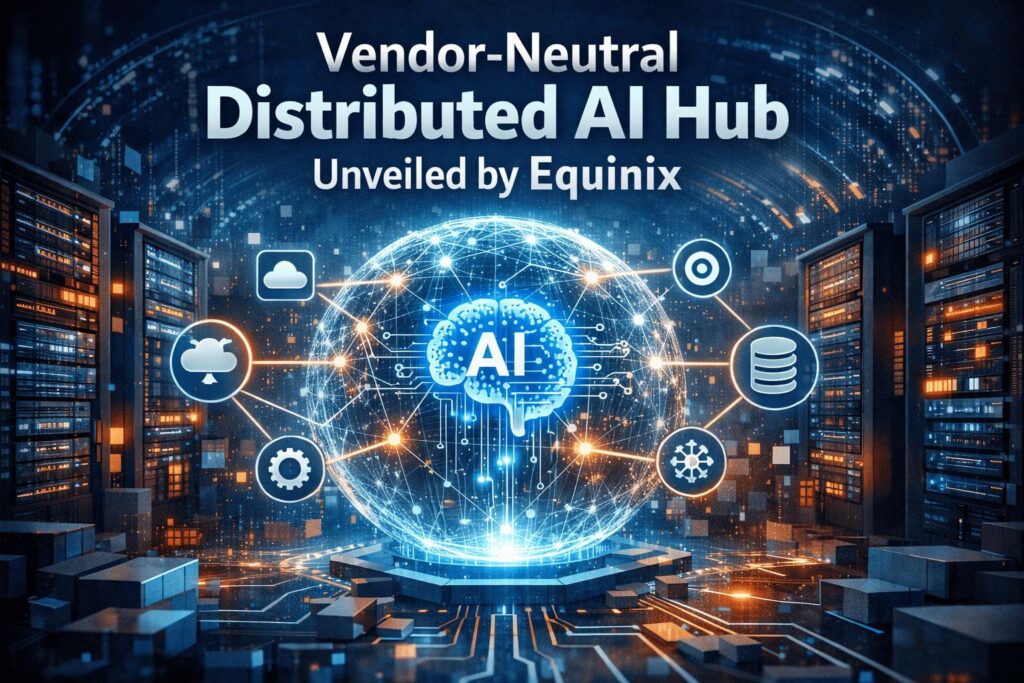
Equinix describes the hub as a neutral location that allows enterprises to discover, connect to, and consume AI infrastructure providers — including model companies, GPU clouds, data platforms, network and security services, and AI tooling — all without redesigning their existing architecture or moving sensitive data between environments.
What the Distributed AI Hub Actually Is
The Distributed AI Hub is a single, unified framework powered by Equinix Fabric Intelligence™ that gives enterprises one place to connect, secure, and simplify their distributed AI ecosystems. Rather than forcing workloads into a single hyperscaler environment, the hub acts as neutral ground where AI, cloud, and networking infrastructure converge. Enterprises can run inference close to where their data already lives, reducing latency and improving performance without making tradeoffs on control or compliance.
Why Vendor Neutrality Is the Game-Changer Here
Unlike hyperscaler AI marketplaces that are designed to keep you inside their own ecosystem, the Distributed AI Hub is open and vendor-neutral by design. That distinction matters enormously. Enterprises get the freedom to select best-of-breed providers for every layer of their AI stack — from the model itself to the GPU compute to the data pipeline — without any single vendor dictating the architecture. According to Equinix, they are building one of the most expansive and neutral AI ecosystems available to enterprise customers today.
The Problem the Distributed AI Hub Solves
The core problem is not a lack of AI tools. There are hundreds of them. The real problem is fragmentation — AI workloads spread across disconnected environments with no unified layer for governance, performance, or security.
AI Workloads Are Sprawled Across Too Many Silos
Most enterprise AI deployments look less like a coherent system and more like a patchwork of point solutions. A model trained in one cloud gets inference requests routed through another, while the raw data it depends on sits in an on-premises environment that neither cloud can access efficiently. This kind of fragmentation drives up costs, increases latency, and creates security gaps that are difficult to audit. The Distributed AI Hub addresses this directly by bringing placement, governance, and predictable performance into the same architecture.
Why Moving Data Between Clouds Kills AI Performance
Data gravity is a real constraint. When large volumes of training data or real-time inference inputs have to cross cloud boundaries, the latency penalty is significant and the egress costs can be punishing. Equinix’s model flips this dynamic by bringing compute to where the data already lives rather than forcing data to move. Running inference close to the data source is not just a performance optimization — it is a fundamental architectural shift that changes what distributed AI can actually do at scale.
Governance and Sovereignty Constraints Are Getting Harder to Manage
Data sovereignty requirements are tightening across almost every regulated industry and geography. Financial services, healthcare, and government organizations face strict rules about where data can reside and who can access it. Managing those constraints across a multi-cloud AI environment, without a neutral control layer, becomes exponentially complex as deployments grow.
The Distributed AI Hub gives enterprises a framework to enforce governance at the infrastructure layer rather than trying to bolt it on after the fact. This matters because AI pipelines that touch regulated data cannot afford ambiguity about where processing happens or who has visibility into it.
Industry analysts have noted that enterprises will increasingly need to deploy distributed edge infrastructure to improve the latency and responsiveness of AI applications, and that unified solutions like the Distributed AI Hub are exactly what the market needs to make that viable. Several key challenges the hub is specifically designed to resolve include:
- Fragmented AI infrastructure spread across incompatible environments
- High latency caused by data moving across cloud boundaries
- Lack of centralized governance over distributed AI workloads
- Difficulty integrating model providers, GPU clouds, and data platforms into a single workflow
- Security blind spots created by multi-vendor AI deployments
- Compliance and data sovereignty obligations that vary by region and industry
One Neutral Platform for Models, GPU Clouds, and Data Services
The Distributed AI Hub brings together every major layer of the AI stack into one discoverable, connectable ecosystem. Model companies, GPU cloud providers, data platforms, network services, and security tooling are all accessible from the same neutral environment. Enterprises do not need separate integration projects for each provider — the hub handles the connectivity layer so teams can focus on building and scaling AI rather than plumbing infrastructure together.
The Palo Alto Networks Security Integration
One of the most significant aspects of this launch is what Equinix built into the security layer. At launch, the Distributed AI Hub includes a direct integration with Palo Alto Networks, embedding real-time threat detection and security enforcement directly into the AI infrastructure stack. This is not an add-on or an afterthought — it is part of the core architecture from day one.
Why this integration matters: AI workloads introduce attack surfaces that traditional perimeter security tools were never designed to handle. Model endpoints, inference APIs, and distributed data pipelines all create new vectors that need active protection at the infrastructure level — not just at the application layer.
Palo Alto Networks brings its AI-powered security capabilities directly into the hub environment, meaning enterprises get threat visibility across their distributed AI workloads without having to deploy and manage separate security tooling for each environment. That consolidation alone reduces operational overhead significantly for security teams already stretched thin managing multi-cloud deployments.
For enterprises in regulated industries, this integration also supports compliance postures that require demonstrable security controls at the infrastructure layer. Rather than trying to prove that a patchwork of cloud-native security tools provides adequate coverage, organizations can point to a unified security framework embedded in the same platform running their AI workloads.
The combination of Equinix’s neutral connectivity and Palo Alto Networks’ threat detection creates something the market has genuinely been missing — a secure-by-design foundation for distributed AI that does not ask enterprises to choose between performance and protection.
Real-Time Threat Detection Built Into AI Workloads
Traditional security models assume a defined perimeter. Distributed AI has no perimeter. Inference requests come from edge locations, training jobs pull data from multiple sources simultaneously, and model outputs flow into downstream systems across cloud boundaries. Palo Alto Networks’ integration addresses this by providing continuous, real-time threat monitoring that follows the workload regardless of where it runs within the Distributed AI Hub ecosystem.
Why Security at the Infrastructure Layer Matters for AI
Securing AI at the application layer means you are already one step behind. By the time a threat reaches the application, it has already traversed the infrastructure that supports it. Building security into the infrastructure layer — where data moves, where compute is allocated, where APIs exchange model inputs and outputs — means threats are identified and contained before they reach critical systems.
This approach also addresses the growing concern around AI model integrity. Adversarial inputs, data poisoning, and model extraction attacks are real threats that enterprise security teams are only beginning to account for in their risk frameworks. Having infrastructure-level visibility into what is flowing through the AI pipeline is a meaningful step toward defending against these emerging attack classes. For more insights into AI infrastructure advancements, you can explore Anthropic AI’s data centre plans.
What Vendor-Neutral Actually Means in Practice
Vendor neutrality is a term that gets used loosely in enterprise technology. In the context of the Distributed AI Hub, it has a specific and consequential meaning: Equinix does not favor any single provider, and no provider on the platform has preferential access to your workloads or data.
No Forced Lock-In to a Single Cloud or AI Provider
Every major hyperscaler has an AI marketplace. Every major cloud provider has incentives to keep your workloads, your data, and your AI spend inside their environment. The Distributed AI Hub is explicitly designed around the opposite principle. Equinix’s business model is built on being the neutral interconnection layer between providers, not on extracting value from the workloads themselves. That structural difference is what makes vendor neutrality credible here rather than just a marketing claim.
How Enterprises Connect to the AI Ecosystem on Their Terms
The hub gives enterprises a single discovery and connection layer for the entire AI ecosystem. Instead of negotiating separate connectivity arrangements with each GPU cloud, model provider, or data platform, enterprises access them all through Equinix Fabric Intelligence™. The connection is private, low-latency, and does not route through the public internet — which matters both for performance and for security.
Provider types accessible through the Distributed AI Hub:
Category What It Provides Model Companies Foundation models and fine-tuned AI capabilities GPU Clouds On-demand compute for training and inference Data Platforms Structured and unstructured data services Network Services Private, high-performance connectivity between environments Security Services Real-time threat detection and compliance tooling AI Tooling MLOps, orchestration, and observability platforms
This single-pane-of-glass approach to AI ecosystem connectivity is a significant operational improvement over the current reality, where enterprises manage separate relationships, contracts, and integration points for each provider in their AI stack.
The practical implication is that an enterprise can swap out a GPU cloud provider, add a new model company, or integrate a new data platform without rebuilding their connectivity architecture. The hub abstracts those integration complexities away, letting teams make infrastructure decisions based on performance and cost rather than switching costs.
Equinix positions this as giving customers the freedom to compose their own AI stack from best-of-breed providers — and that framing is accurate. It is the difference between being a tenant in someone else’s ecosystem and being the architect of your own.
Flexibility to Run Workloads Where They Perform Best
Performance-optimal placement of AI workloads is one of the hardest problems in distributed infrastructure. Training jobs have different requirements than inference. Real-time inference has different latency tolerances than batch processing. Edge inference has different connectivity requirements than centralized model serving. The Distributed AI Hub is designed to support all of these patterns from a single framework without requiring enterprises to build separate infrastructure strategies for each one.
Equinix’s global footprint enables this flexibility in a way that a single cloud provider simply cannot match. With physical presence across hundreds of locations worldwide, the hub can place AI workloads close to the data sources, users, or downstream systems they need to interact with — regardless of which cloud or compute environment is best suited for that specific workload.
Workload placement flexibility in the Distributed AI Hub:
- Training workloads can leverage high-density GPU clouds accessed through private Fabric connections
- Real-time inference runs close to the data source, eliminating cross-cloud latency penalties
- Batch inference can be routed to cost-optimized compute without changing the broader architecture
- Edge AI deployments connect back to the hub for model updates and governance oversight
This is what makes the Distributed AI Hub viable at enterprise scale. It is not just a connectivity product — it is an architectural framework that resolves the fundamental tension between where data lives, where compute is available, and where AI output needs to be delivered.
Global Availability and Deployment at Enterprise Scale
The Distributed AI Hub launches with global availability, backed by Equinix’s network of over 260 data centers across more than 70 metros worldwide. That footprint is not incidental — it is the foundation that makes the hub’s distributed architecture meaningful. An enterprise in Frankfurt, Singapore, or São Paulo gets access to the same neutral AI ecosystem with the same private connectivity model, without having to route through a centralized hub region that introduces latency.
For multinational enterprises managing AI deployments across regions with different data sovereignty requirements, this global reach combined with local presence is exactly the architecture they need. Workloads stay in the region they belong in, governance policies are enforced at the infrastructure layer, and connectivity to global AI providers remains private and performant regardless of geography.
Who Benefits Most From the Distributed AI Hub
While the Distributed AI Hub has broad applicability, certain enterprise profiles will see the most immediate and significant impact from this platform.
Enterprises With Multi-Cloud AI Infrastructure
Any organization already running AI workloads across more than one cloud environment is dealing with the fragmentation problem the hub is designed to solve. The operational overhead of managing connectivity, security, and governance across AWS, Azure, Google Cloud, and private environments simultaneously is substantial. The Distributed AI Hub gives these organizations a single, neutral layer that sits above all of those environments and unifies them without requiring migration or architectural reinvention.
For enterprises that have made significant investments in specific cloud environments and are not willing to abandon them, this is particularly compelling. The hub does not ask you to choose — it connects what you already have and adds the governance and performance layer that multi-cloud AI has been missing.
Organizations With Data Sovereignty or Compliance Requirements
Regulated industries have the most to gain from a vendor-neutral distributed AI hub with governance baked into the infrastructure layer. Banks, insurers, healthcare systems, and government agencies all operate under frameworks that dictate where data can reside, who can process it, and what audit trail must exist around that processing. The Distributed AI Hub enforces these constraints at the infrastructure level, which is the only place where enforcement is truly reliable — not at the application layer where policy drift is a constant risk.
The combination of Equinix’s local presence across global metros and the private connectivity model of Fabric Intelligence™ means regulated enterprises can build AI pipelines that never expose sensitive data to the public internet and never move it across a jurisdictional boundary without explicit architectural intent. For compliance teams, that is not a nice-to-have — it is a prerequisite for deploying AI at scale in regulated environments.
The Distributed AI Hub Reframes What Enterprise AI Infrastructure Looks Like
The Distributed AI Hub does not just solve a connectivity problem. It reframes the entire question of how enterprise AI infrastructure should be built. Instead of asking “which cloud should we run our AI on,” enterprises can now ask “where does our AI perform best” — and get a real answer backed by neutral infrastructure. Equinix is providing the freedom to build and scale AI wherever data, partners, and teams already live, while running inference close to the data and removing the forced tradeoffs that have defined enterprise AI deployments until now. That shift in architectural thinking is the most consequential thing this platform delivers, and it will shape how enterprises approach AI infrastructure for years to come.
Frequently Asked Questions
Below are the most common questions enterprises are asking about the Distributed AI Hub and what it means for their AI infrastructure strategy.
What is Equinix’s Distributed AI Hub?
The Distributed AI Hub is a vendor-neutral platform launched by Equinix that provides a single, unified framework for enterprises to connect, secure, and simplify their distributed AI ecosystems. Powered by Equinix Fabric Intelligence™, it brings together data, compute, cloud platforms, model companies, GPU clouds, and AI tooling in one neutral environment. Enterprises can discover, connect to, and consume AI infrastructure providers without redesigning their existing architecture or relocating data.
What does vendor-neutral mean in the context of the Distributed AI Hub?
Vendor-neutral means the Distributed AI Hub does not favor any single cloud provider, model company, or AI tooling vendor. Unlike hyperscaler AI marketplaces that are designed to keep workloads within their own ecosystem, the hub is open by design — giving enterprises the freedom to select best-of-breed providers for every layer of their AI stack without lock-in or preferential routing to any one provider.
Equinix’s business model is built on being the neutral interconnection layer between technology providers, not on capturing value from the workloads running on top of it. That structural position is what makes vendor neutrality a credible architectural guarantee here rather than a marketing positioning statement.
How does Equinix Fabric Intelligence power the Distributed AI Hub?
Equinix Fabric Intelligence™ is the connectivity and intelligence layer that underpins the entire hub. It provides private, low-latency connections between enterprises and the AI providers within the hub ecosystem — bypassing the public internet entirely. This means workload traffic between a GPU cloud, a model provider, and an enterprise’s data environment travels over a dedicated, high-performance fabric rather than shared public infrastructure. Fabric Intelligence also provides the placement intelligence that enables enterprises to route AI workloads to the environment where they will perform best based on real-time conditions.
Why did Equinix partner with Palo Alto Networks for this launch?
Distributed AI workloads create security challenges that traditional perimeter-based tools were never designed to handle. Model endpoints, inference APIs, and multi-environment data pipelines all introduce attack surfaces that need active, continuous monitoring at the infrastructure layer. Equinix partnered with Palo Alto Networks to embed real-time threat detection and security enforcement directly into the hub architecture from day one, rather than leaving enterprises to bolt on third-party security tooling after deployment.
The integration means enterprises get unified security visibility across their distributed AI workloads without managing separate security stacks for each environment in their AI pipeline. For regulated industries in particular, this provides the demonstrable infrastructure-level security controls that compliance frameworks increasingly require for AI deployments handling sensitive data.
How many data centers is the Distributed AI Hub available in?
The Distributed AI Hub launches with global availability across Equinix’s network of over 260 data centers spanning more than 70 metro areas worldwide. This global footprint means enterprises in North America, Europe, Asia-Pacific, and Latin America all have access to the same neutral AI ecosystem with local presence that supports data sovereignty and low-latency workload placement requirements.
Can enterprises use the Distributed AI Hub without changing their existing architecture?
Yes. One of the core design principles of the Distributed AI Hub is that enterprises should be able to connect to and benefit from the platform without rebuilding their existing infrastructure. The hub sits as a neutral layer that connects to environments enterprises already operate in — whether that is AWS, Azure, Google Cloud, or private on-premises infrastructure — through Equinix Fabric Intelligence™ private connections.
This means an enterprise does not have to migrate workloads, retrain teams on a new platform, or renegotiate existing cloud contracts to start using the hub. They connect their existing environments to the hub and immediately gain access to the broader AI ecosystem, the governance framework, and the security integration that the platform provides.
For enterprises that have made significant prior investments in specific cloud environments or proprietary AI tooling, this non-disruptive integration model is critical. The hub is designed to add capability on top of existing infrastructure, not replace it — making the adoption path significantly lower risk than a wholesale migration to a new AI platform would be.
What types of AI workloads is the Distributed AI Hub designed to support?
The Distributed AI Hub is designed to support the full range of enterprise AI workload types across the complete AI lifecycle. This includes large-scale training jobs that require high-density GPU compute, real-time inference workloads that need to run close to the data source with minimal latency, batch inference jobs that can be routed to cost-optimized compute, and edge AI deployments that need connectivity back to centralized governance and model management systems.
The platform is also specifically designed for multi-model AI architectures, where enterprises are running multiple foundation models from different providers as part of a single AI workflow. Rather than managing separate connectivity and security arrangements for each model provider, the hub gives enterprises a single access point to the entire model ecosystem with consistent governance applied across all of them.
Equinix is positioning the Distributed AI Hub as the infrastructure foundation for enterprise AI at any stage of maturity — from organizations just beginning to scale their first production AI deployments to enterprises running complex, multi-region AI systems that require sophisticated placement, governance, and security capabilities. If your AI infrastructure has grown beyond what a single cloud environment can cleanly support, the Distributed AI Hub is the architecture that makes the next stage of scale possible. Equinix continues to expand its neutral AI ecosystem, making it one of the most comprehensive and accessible distributed AI infrastructure platforms available to enterprise teams today. For more on AI infrastructure developments, see Anthropic AI’s data centre plans.